Overview
At a glance
Is this game right for my group?
ABG editorial scores on a 1–5 scale.
Harder to teach
High replayability
Highly interactive
Scales well
Deep strategy
How it plays
How does it play?
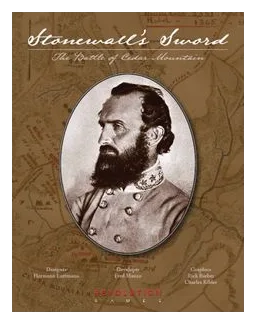
Stonewall's Sword: The Battle of Cedar Mountain is a two-player wargame on The Battle of Cedar Mountain, August 9th, 1862. One player commands Thomas "Stonewall" Jackson's Confederate troops and the other controls Nathaniel Banks' Union troops.
Core mechanisms
Key systems that shape the decisions players make.
Dice Rolling
Roll dice to introduce uncertainty into actions, production, movement, or resolution.
Chit-Pull System
Draw tokens to determine which units, factions, or events activate next.
Events
Triggered events alter the shared state, rules, or available choices.
Hexagon Grid
Use a hexagonal map where each space connects evenly in six directions.
Read the full game description
Stonewall's Sword: The Battle of Cedar Mountain is a two-player wargame on The Battle of Cedar Mountain, August 9th, 1862. One player commands Thomas "Stonewall" Jackson's Confederate troops and the other controls Nathaniel Banks' Union troops. Players win by controlling key areas of the map and by earning victory points by eliminating enemy units. There are two scenarios available, each with their own victory conditions, length, and aspect of the battle that is focused on. Stonewall's Sword: The Battle of Cedar Mountain also features the Blind Swords chit-pull system which emphasizes the three “FOW’s” of military conflict: fog-of-war, friction-of-war and fortunes-of-war. With each chit pull, players will be challenged to make tough decisions based on their assessment of the current situation. Unlike traditional chit-pull mechanisms, the Blind Swords system ensures that no combat units can be counted on, or conversely, counted out. This yields an environment of tense action and constant surprises – an environment that will challenge each player. Charles Kibler created the artwork for the counters and Rick Barber is the artist for the map.