Overview
At a glance
Is this game right for my group?
ABG editorial scores on a 1–5 scale.
Highly interactive
How it plays
How does it play?
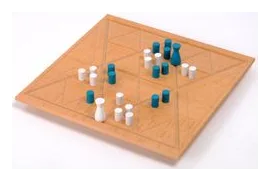
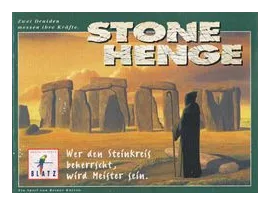
Stonehenge is a two-player game that has druids competing at Stonehenge to be the Master Druid. Each player has 8 coloured megaliths (tall wooden blocks) and 9 matching discs (numbered 1,1,2,2,3,3,4,5, & 6).
Core mechanisms
Key systems that shape the decisions players make.
Read the full game description
Stonehenge is a two-player game that has druids competing at Stonehenge to be the Master Druid. Each player has 8 coloured megaliths (tall wooden blocks) and 9 matching discs (numbered 1,1,2,2,3,3,4,5, & 6). The board is a triangle of 5 dissecting lines, with the corners lopped off, so the lines are 2,3,4,5,4 spaces long. On each side are 5 extra spaces, where players put their megaliths. Players take turns putting down a numbered disc on the intersections of the lines on the board. When you have the majority total in any direction, you claim that line by placing your megalith on the end point. Ties on a line are lost by the last placing player; a clever balancing rule which forces careful choices. The player to get their eighth megalith down wins. Stonehenge is the same as Linea (Spielbox 1992, smaller board). The Megalith edition is Selection #9 of The Games Collection by Pin International.