Overview
At a glance
Is this game right for my group?
ABG editorial scores on a 1–5 scale.
Harder to teach
High replayability
Highly interactive
Scales well
Deep strategy
How it plays
How does it play?
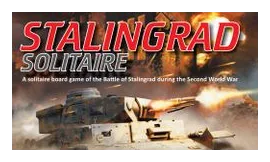
Stalingrad Solitaire is a solitaire game simulating the last weeks of the encircled German 6th Army in the pocket German troops nicknamed “The Cauldron” that formed in and to the west of the city of Stalingrad when Soviet troops broke through the Wehrmacht’s front lines in December 1942. You represent 6th Army’s commander, General Paulus.
Core mechanisms
Key systems that shape the decisions players make.
Movement Points
Spend a movement allowance across spaces with different costs.
Dice Rolling
Roll dice to introduce uncertainty into actions, production, movement, or resolution.
Point-to-Point Movement
Move along explicit connections between named locations or nodes.
Simulation
Model a real or imagined system through detailed cause-and-effect rules.
Solo / Solitaire Game
Provide rules and objectives designed for a single player.
Read the full game description
Stalingrad Solitaire is a solitaire game simulating the last weeks of the encircled German 6th Army in the pocket German troops nicknamed “The Cauldron” that formed in and to the west of the city of Stalingrad when Soviet troops broke through the Wehrmacht’s front lines in December 1942. You represent 6th Army’s commander, General Paulus. All actions of the Soviet commander Zhukov and subordinate units are strictly controlled by the game rules. As Paulus, your goal is to save the trapped army in the Cauldron while at the same time cooperating with the high command (OKW) to preserve the integrity of the entire southern front in Russia. Each turn you perform various types of actions within the pocket. Die rolls and rules determine the strategic situation and strategy employed by Army Group South outside the pocket, specifically in terms of the commitment levels of the Luftwaffe (air force) and General Hoth's relief force. Each turn represents one to five days, depending on the level of activity. The entire board represents territory approximately 35 by 65 miles. German units typically represent divisions, while Soviet units are officially armies that were usually the rough equivalent of a German division. Each supply point represents about 50 tons delivered per day. Each evacuated wounded factor represents 1500 men. This war game is big in scope (and lettering) and can be played in a (long) evening. Rather than standard 9/16" or even 5/8" inch counters, this game utilizes our custom 3/4" square counter die to create large, thick counters that are easy to see and manipulate. The base game also contains a map with easy ergonomics, and a well tested game system that approaches its subject with enough abstraction to keep the game tight, but enough detail to do justice to history and create an array of complex decisions. The map represents the city of Stalingrad and surrounding area and contains 64 areas for regulating movement and combat. Each area is linked to every other area it is connected to by a line. The player controls all vacant areas inside the German Perimeter marked on the map. The player also controls all areas containing German units, regardless of their location. Any vacant area outside the Perimeter or occupied by a Soviet unit are under Soviet control. No area may contain units from both sides. Game counters represent combat units and information markers. German units are blue, their Rumanian allies are yellow, Soviet units are red, and information markers are white. The number of counters provided in the game is deliberately limited. Cards are used to determine outcomes for weather, offensives, as well as individual attacks, and provide random changes to the game state as well as randomised situations.