Overview
At a glance
Is this game right for my group?
ABG editorial scores on a 1–5 scale.
Harder to teach
High replayability
Highly interactive
Scales well
Deep strategy
How it plays
How does it play?
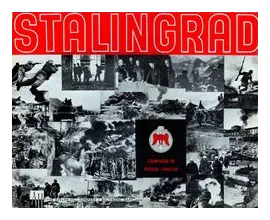
The original edition came out in 1963 in a double-size box. The large box was nearly twice the area of a traditional AH box.
Core mechanisms
Key systems that shape the decisions players make.
Grid Movement
Move pieces between adjacent spaces on a regular grid.
Dice Rolling
Roll dice to introduce uncertainty into actions, production, movement, or resolution.
Movement Points
Spend a movement allowance across spaces with different costs.
Hexagon Grid
Use a hexagonal map where each space connects evenly in six directions.
Combat Results Table
Compare opposing strength as a ratio, then consult a table to resolve combat.
Read the full game description
The original edition came out in 1963 in a double-size box. The large box was nearly twice the area of a traditional AH box. Later the game came out in a traditional-size box. A second edition with clarified rules was issued in 1974 with the same standard size box but thinner. The rules are fairly straightforward. The strategies are extremely deep. Stalingrad is by far the most thoroughly and deeply analyzed board war game. Furthermore, the game preserves interest for players at a wide range of levels. Stalingrad is a good game to use to introduce players to hex-based war games. Stalingrad uses a move-combat sequence, alternating between players. There is limited advance (one hex) or retreat (two hexes) after combat. Units have one-hex thick zones of control; movement directly from one hex in the zone of control of a unit into an adjoining hex of the zone of control of the same unit is not allowed. Functional terrain includes swamp (one hex per turn movement), mountains (one hex per turn movement, defenders are doubled), major cities (defenders doubled), rivers (defenders behind rivers are doubled if attacked only across the river), railroads (ten hex movement bonus, must be taken all at once), lakes (impassible). Weather is good in summer, snow in winter, and governed by a table in the spring and fall. Mud halves ground movement. Snow halves ground and rail movement, and freezes (converts to clear terrain) some swamps, rivers, lakes, and oceans. Combat is mandatory between units that are adjacent at the end of each turn, but the attacker chooses which units attack which other units, so long as all adjacent units are in some battle. The classical Avalon Hill D6 table, with results such as D Elim, A Elim, etc is in use. Germans have limited replacements; Russian replacement rates escalate as the game goes on. The objective is to capture the opposition's key cities (for the Russians, Leningrad, Moscow, Stalingrad) or to destroy the other side's army. The Russian (implicit in rules) can also win by taking Helsinki, Warsaw, and Bucharest, and holding them for two complete turns, but I have never heard of this being done between normal players. Several extremely bad German strategic plans are in wide use. Avalon Hill Complexity rating - 2