Overview
At a glance
Is this game right for my group?
ABG editorial scores on a 1–5 scale.
Harder to teach
High replayability
Highly interactive
Scales well
Deep strategy
How it plays
How does it play?
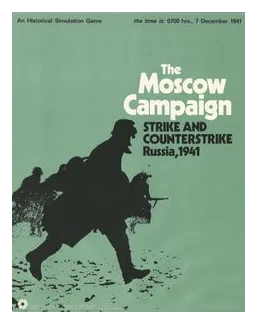
The Moscow Campaign; Strike and Counterstrike Russia, 1941, is the successor to SPI's earlier treatment of roughly the same events, The Battle of Moscow (originally published in Strategy & Tactics magazine #24).
Core mechanisms
Key systems that shape the decisions players make.
Grid Movement
Move pieces between adjacent spaces on a regular grid.
Dice Rolling
Roll dice to introduce uncertainty into actions, production, movement, or resolution.
Movement Points
Spend a movement allowance across spaces with different costs.
Hexagon Grid
Use a hexagonal map where each space connects evenly in six directions.
Combat Results Table
Compare opposing strength as a ratio, then consult a table to resolve combat.
Read the full game description
The Moscow Campaign; Strike and Counterstrike Russia, 1941, is the successor to SPI's earlier treatment of roughly the same events, The Battle of Moscow (originally published in Strategy & Tactics magazine #24). The Moscow Campaign covers the final German drives on the Russian capital and the first Soviet counteroffensive. The scale is 6 miles per hex and three days per turn. Units (blue Germans and brown Soviets) are predominantly divisions. The Soviets have a few corps, and some German mechanized divisions are replaced by kampfgruppen if eliminated in combat. Though they have "historical" designations, the formations are pretty generic. They display combat factors, movement allowances and NATO symbols. Most formidable are the German 6-8 panzer divisions; most common are the lowly Soviet 1-4 infantry. Games can begin as early as September 30, 1941, and end as late as December 31st. A variety of starting points, ending points and German orders of battle produce 24 scenarios, four lasting all 31 turns, the rest - centered on the German offensives in early October and late November and the Soviet riposte at the end of the year - 8 turns each. The four-color map is functional though not an aesthetic gem. It shows cities, rivers, railroads, forests, swamps, lakes, Soviet fortifications and scenario start lines. Players alternate turns, each having a movement phase, combat phase and second movement phase for mechanized units. Zones of control are "semi-active" (requiring extra movement points to enter or leave but not mandating combat between adjacent enemies). The stacking limit is three units of any size per hex. The Combat Results Table has the classic Eliminate, Exchange, Retreat outcomes. Overruns during movement are also possible, though they require 11 to 1 odds. Germans must trace supply lines to railroads that have been converted by Eisenbahn Bautruppen, Soviets to unconverted rail lines that run to the north, south or east of the map. Lack of supply halves movement and combat factors but doesn't, by itself, result in elimination. Weather changes historically. Rain, mud and full winter successively erode movement allowances and combat strengths. There are no air or command rules. Victory points are awarded for destroying enemy units and for geographical objectives (possession of Moscow for either side, proximity to Moscow for the Germans, pushing units west of the start line for the Soviets). When published, this was one of SPI's largest and most sophisticated games. Game Scale: Game Turn: 2 days Hex: 6 miles / 9.6 kilometers Units: Brigade to Corps Game Inventory: One 22 x 34" four-color mapsheet One single-side printed countersheet (400 1/2" counters) One 10-page foldout Moscow Campaign folder One 6-sided die Solitaire Suitability: Medium Complexity Level: Medium Players: 2 or more Playing Time: 2-4 hours