Overview
At a glance
Is this game right for my group?
ABG editorial scores on a 1–5 scale.
Harder to teach
High replayability
Highly interactive
Scales well
Deep strategy
How it plays
How does it play?
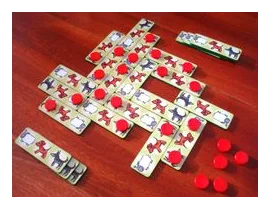
Sheep, Dogs and Wolves, invented by Néstor Romeral Andrés and his daugther Elena (at age 4), is a tile-laying game for two players (sheep and wolf) who share a common pool of rectangular pieces depicting a sheep, a dog and a wolf, in that order.
Core mechanisms
Key systems that shape the decisions players make.
Read the full game description
Sheep, Dogs and Wolves, invented by Néstor Romeral Andrés and his daugther Elena (at age 4), is a tile-laying game for two players (sheep and wolf) who share a common pool of rectangular pieces depicting a sheep, a dog and a wolf, in that order. The sheep player must save as many sheep as possible, while the wolf must feast on those sheep. Chomp! Sheep, Dogs and Wolves has two types of game play: Duel: The players play two complete games, switching roles after the first game. Whoever saves more sheep wins. Bid: Before the game starts, players take turns make increasing bids as to how many sheep they think they can save. The player who passes first plays the wolf; the other player must save at least as many sheep as he bid to win. To start play, place one tile on the table. Players, starting with the sheep, alternate placing tiles on the table, with each tile needing to fit in an imaginary square grid and being adjacent to at least one already-placed tile. Once all tiles have been placed, the game ends. To score, first place a counter on each wolf that has at least two dogs orthogonally adjacent to it; these wolves are "scared" of the dogs and won't eat sheep. Next, place a counter on each sheep adjacent at least to one uncovered wolf; these sheep have been eaten by the wolves. Count each uncovered sheep; these sheep are safe, and the total number of safe sheep is the sheep player's score.