Table feel
Quadrum has a high level of direct confrontation and strategic depth in confrontation. Players need to frequently pay attention to and react to others' strategies and turns. However, there is less emphasis on cooperation in the game.
Players
2
Time
?-?
Age
6+
Weight
1.5
Rating
6.26
Teaching signal
High replayability
Highly interactive
Scales well
Deep strategy
Luck-sensitive
Quadrum has a high level of direct confrontation and strategic depth in confrontation. Players need to frequently pay attention to and react to others' strategies and turns. However, there is less emphasis on cooperation in the game.
Quadrum offers a high level of variability with its gameboard, multiple paths to victory, and variable setups. The presence of expansions adds further content and gameplay elements. The game provides deep strategic possibilities and room for improvement over time. It adapts well to different player counts without compromising its appeal or balance. While it may take some time to learn, the depth it offers makes it worth the effort, resulting in a strong replayability score of 8.05.
Quadrum has a moderate influence of luck. Random elements have a notable but not exclusive impact on the game outcome. Players have substantial ability to mitigate randomness through strategic decisions and planning. The game outcome is primarily determined by player strategy and decisions, with luck playing a minor role.
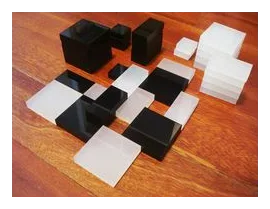
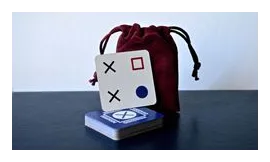
It is like dominoes, but with more strategy. The game consists of 24 (playing card) tiles. The tiles are dealt face up, 12 to each player, at the beginning of the game and remain face up for the entire game. Players take turns playing tiles to the board and the player who uses all their tiles first wins. Each tile has a one of three different symbols (cross, circle or square) is each of the corners - exactly one card of all possible combinations up to rotation. To legally place a tile on the board it must be placed next at least one other tile and both the symbols along the common edge must match. The main strategic aspect comes from the additional rule that if a player places a tile next to two or more tiles (such as in a "corner") then they get to have another turn (with no limit on extra tuns achieved this way).
No media imported yet.
| Edition | Year | Language | Publisher / Region |
|---|---|---|---|
| No editions imported yet. | |||
No files imported yet.
No commerce mappings imported yet.
No linked items imported yet.