Overview
At a glance
Is this game right for my group?
ABG editorial scores on a 1–5 scale.
Harder to teach
High replayability
Highly interactive
Scales well
Deep strategy
How it plays
How does it play?
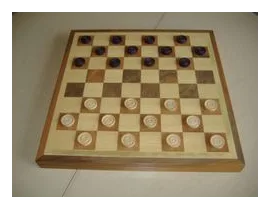
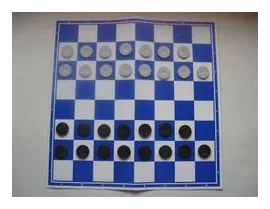
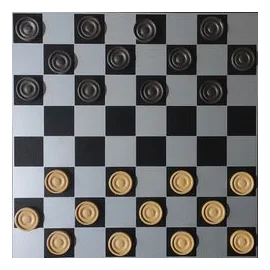
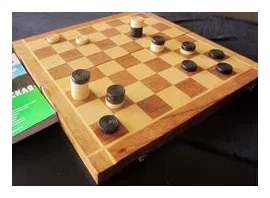
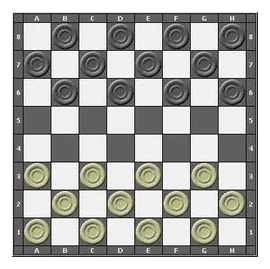
The Russian form of Checkers The rules differ in several ways from other forms, making it a distinct game. Shashki is played on the black fields of an 8x8 board.
Read the full game description
The Russian form of Checkers The rules differ in several ways from other forms, making it a distinct game. Shashki is played on the black fields of an 8x8 board. A man (?????) moves forwards only, but it can capture forwards and backwards. Men are promoted to kings (?????, actually meaning lady) upon reaching the back row. If this happens within a capture, the piece is promoted, too, and must, if possible, carry on capturing as a king. Kings fly in movement and capture. A move may not end when there is still a capture possible, but there is no need to choose the path with the maximum number of captures. The game ends when a player cannot move, either because his pieces are blocked or because he lost them all. Shashki was the dominant game in Russia before the rise of Chess. It is still very popular and played in tournaments. There is a plethora of variants, some of which, notably Bashni (column Shashki) and Shashki Poddavki (give-away Shashki), are played in tournaments as well.