Overview
At a glance
Is this game right for my group?
ABG editorial scores on a 1–5 scale.
Harder to teach
High replayability
Highly interactive
Scales well
Deep strategy
How it plays
How does it play?
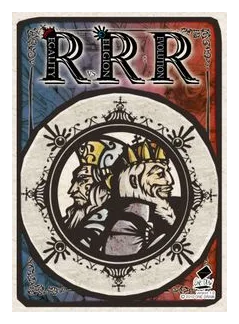
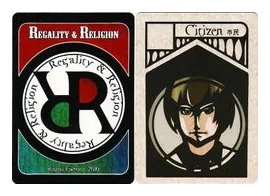
Seiji Kanai created the two-player abstract game RR – Regality and Religion – for a design competition with this restriction: "Create a game for 500 yen" (about $5). The game consists of 15 cards.
Core mechanisms
Key systems that shape the decisions players make.
Read the full game description
Seiji Kanai created the two-player abstract game RR – Regality and Religion – for a design competition with this restriction: "Create a game for 500 yen" (about $5). The game consists of 15 cards. Both players start with a set of seven identical cards that act as pawns on a 3x3 board. Players take turns placing one of their cards in hand onto the board, with the card facing the active player. Some cards, when placed, rotate one or more of the surrounding cards upside down, making them face the other way; other cards destroy surrounding cards. The game ends when the board is full, at which point the player with the most cards facing him wins. Re-implemented by: RRR – Regality vs. Religion: Revolution, an enhanced version of RR, comes in a box with a game board, card board tiles instead of cards, and eleven "neutral" tiles, five of which are randomly used in each game and available to both players.