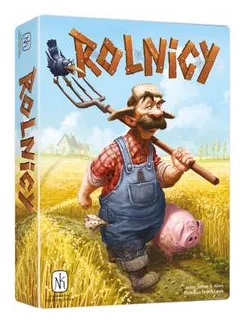
Overview
At a glance
Is this game right for my group?
ABG editorial scores on a 1–5 scale.
Harder to teach
High replayability
Highly interactive
Scales well
Deep strategy
How it plays
How does it play?
In Rolnicy, you and your fellow farmers are cultivating five types of crops: potatoes, grain, lavender, sunflowers, and pumpkins. You use your cards to work in the collective farm shared by all, but you also have a private plot of land that no one else can touch.
Core mechanisms
Key systems that shape the decisions players make.
Read the full game description
In Rolnicy, you and your fellow farmers are cultivating five types of crops: potatoes, grain, lavender, sunflowers, and pumpkins. You use your cards to work in the collective farm shared by all, but you also have a private plot of land that no one else can touch. By harvesting crops from both fields (adding them together), you can win valuable production cards. You can score each crop only once during the game, so timing is important! In more detail, each turn you must plant two domino-style land cards from your hand, then draw two cards from the deck to refill your hand. During your turn, you may also be able to harvest fields in order to take one production card. Plant the first card in front of you on your private plot so that it forms a grid of square fields. You can place it next to a previously placed card or cover one or two fields of any previously placed cards. However, your private plot can be a maximum of three fields in each direction (3x3). Plant the second card in the central collective farm, with exactly one field of this card covering a previously played field. You may then harvest one of the crops on the card placed in the collective farm. To harvest a field, count the number of orthogonally connected fields of the same crop that are also connected with the crop you just planted. When the deck is exhausted, play continues until all hand cards have been played. Alternatively, when a player takes their fifth production card — that is, has collect each type of crop once — the game ends at the end of the round. Each player then sums the points on the production cards in front of them, and the player with the most points wins!