Overview
At a glance
Is this game right for my group?
ABG editorial scores on a 1–5 scale.
Harder to teach
High replayability
Highly interactive
Scales well
Deep strategy
How it plays
How does it play?
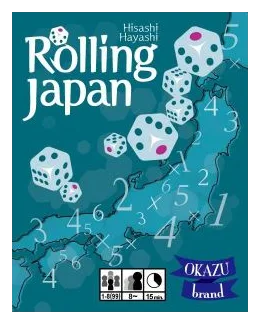
Rolling Japan is a light "multiplayer solitaire" dice game. Each player has a map of Japan that's divided into the 47 prefectures, which are then bunched together into six differently colored areas.
Core mechanisms
Key systems that shape the decisions players make.
Read the full game description
Rolling Japan is a light "multiplayer solitaire" dice game. Each player has a map of Japan that's divided into the 47 prefectures, which are then bunched together into six differently colored areas. On a turn, a player draws two regular six-sided dice from a bag and rolls them; the bag starts with seven dice, six matching the colors of the areas on the map along with a wild purple die. All players now write down each number rolled on any prefecture of the matching color, i.e., if the blue die shows 4 and the yellow a 2, write a 4 in one blue prefecture and a 2 in one yellow prefecture. If the purple die is rolled, you can place this number in a prefecture of your choice; additionally, three times per game you can choose to use a non-purple die as any color. However, neighboring prefectures — including those in different areas connected by blue lines — can't have numbers with a difference larger than 1; if you can't place a number without breaking this rule, then you must place an X in a prefecture of the appropriate color. (If all the prefectures in an area are filled, you can ignore the die or use one of your three color changes to place the number elsewhere.) After six dice have been rolled, mark one round as being complete, then return the dice to the bag and start the next round. After eight rounds the game ends, and whoever has the fewest Xs on her map wins.