Overview
At a glance
Is this game right for my group?
ABG editorial scores on a 1–5 scale.
Harder to teach
High replayability
Highly interactive
Scales well
Deep strategy
How it plays
How does it play?
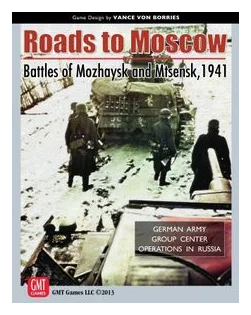
Roads to Moscow: Battles of Mozhaysk and Mtsensk, 1941 is a two-player game depicting battles in the Soviet Union during the drive on Moscow in October 1941.
Core mechanisms
Key systems that shape the decisions players make.
Read the full game description
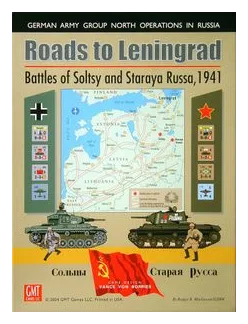
Roads to Moscow: Battles of Mozhaysk and Mtsensk, 1941 is a two-player game depicting battles in the Soviet Union during the drive on Moscow in October 1941. The two separate battles shown in this game are named for the main objective city on each map, Mozhaysk to the west of Moscow, and Mtsensk to the south. Perhaps the most dramatic of the many desperate battles fought in front of Moscow, these two battles combined all the elements of the great struggle. The Germans have an excellent fighting machine but are short on fuel and time. They must capture their objectives on a tight schedule or snow and mud will end their offensive. The Soviets are down to the rearward remnants of their once immense armies. If the Soviets can avoid being encircled by the fast moving German forces, high quality reinforcements from the Far East may finally allow them to stop the German advance. Historically, the Soviets stood fast at Mozhaysk, fighting heavily even on the old Napoleonic battlefield of Borodino. Like Napoleon, the Germans eventually took the field, but at great cost in time and manpower. Near Mtsensk Guderian’s Panzer spearhead advancing north from Orel was ambushed by the Soviets thereby disrupting the German timetable. This gave the Soviet 6th Guards Rifle Division time to dig-in on the heights above Mtsensk thereby barring the way to Tula and Moscow. Roads to Moscow uses the same mechanics found in the acclaimed Roads to Leningrad game, featuring a chit draw for activation of formations. Both players quickly learn how to use their motorized units effectively for overruns, combined arms, and movement of reserves. The game includes special rules for Soviet rocket artillery, NKVD, and self-propelled gun units, and fuel supply shortages, and much more, all without overwhelming play of the game. Game Scale: Turn: 12 hours Hex: 1.4km (Mozhaysk ), 1.2km (Mtsensk) Unit: Company to Battalion for most combat units, with Brigade & Division HQs COMPONENTS Three counter sheets (528 5/8" counters) One 22" x 34" Mapsheet (front & back printed) 4 Player Aid set-up cards 1 Charts & Tables card Rule book Play book 1 ten-sided die DESIGNER: Vance von Borries DEVELOPER: Mark Guttag ART DIRECTOR: Rodger B. MacGowan MAP & COUNTER ART: Charles Kibler (source: GMT website)