Overview
At a glance
Is this game right for my group?
ABG editorial scores on a 1–5 scale.
Harder to teach
High replayability
Highly interactive
Scales well
Deep strategy
How it plays
How does it play?
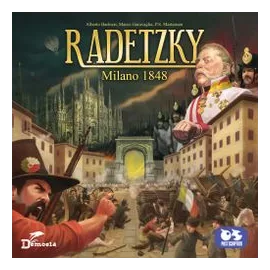
Smoke rises from the barricades, messengers dart among the rebels' outposts, the air is thick and vibrant with expectations...
Core mechanisms
Key systems that shape the decisions players make.
Push Your Luck
Choose whether to secure current gains or risk them for a larger reward.
Area Movement
Move pieces between connected regions rather than along individual spaces.
Cooperative Game
Players coordinate their actions toward a shared objective and win or lose together.
Hand Management
Time and sequence a limited hand of cards to preserve future options.
Set Collection
Gather related items that become more valuable when scored together.
Rock-Paper-Scissors
Resolve choices through a circular set of strengths and weaknesses.
Read the full game description
Smoke rises from the barricades, messengers dart among the rebels' outposts, the air is thick and vibrant with expectations... Radetzky: Milano 1848 is a cooperative game in which players act as the people of Milano rising against the Austrian Empire, represented by Austrian soldiers and their leader, Field Marshal Joseph Radetzky. In each turn, players can take up to three actions, with a choice among: Move to a different area Use a special ability Increase a special ability's effect Refill their hand Conquer a territory Fight against the Soldiers Fight against Field Marshal Radetzky Fights are the core of the game: players must respond to Austrian cards using the appropriate ones from their hand. If two or more players are on the same area, they can join and fight together. They can go on fighting until they decide to stop... or until they win (or lose!). The game ends when one of the two factions conquers 5 of the 16 areas in which the city is divided. —description from the publisher