Overview
At a glance
Is this game right for my group?
ABG editorial scores on a 1–5 scale.
Harder to teach
High replayability
Highly interactive
Scales well
Deep strategy
How it plays
How does it play?
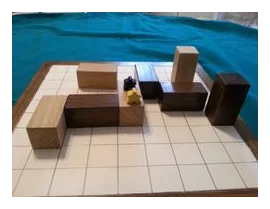
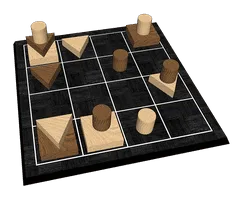
Pyrga is a 2-player abstract strategy game. Players are architects who build Towers on a 4x4 grid.
Core mechanisms
Key systems that shape the decisions players make.
Read the full game description
Pyrga is a 2-player abstract strategy game. Players are architects who build Towers on a 4x4 grid. Each piece put into play indicates where the opponent is allowed to put their next piece. The first player to control 3 Towers wins the game. 1) Each space of the board can only support 1 Tower, made of 1 piece of each kind: Square, Triangle and Cylinder, of the same color or not. The order in which the pieces are played on a same square does not matter. 2) If the piece just played by the opponent is a Square, then one must play on one of the adjacent spaces. 3) If the piece just played by the opponent is a Triangle, then one must play along the line indicated by the Triangle. When a Triangle is put into play, the player chooses its orientation. It is forbidden to point the triangle directly against the outer edge of the board. Once played, a Triangle cannot be re-oriented. 4) If the piece just played by the opponent is a Cylinder, the player must play on the same space. —description from the publisher