Overview
At a glance
Is this game right for my group?
ABG editorial scores on a 1–5 scale.
Harder to teach
High replayability
Highly interactive
Scales well
Deep strategy
How it plays
How does it play?
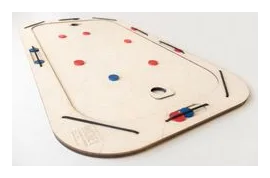
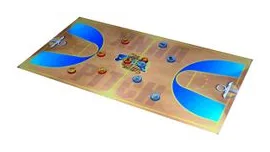
Pitch'n Dunk uses the mechanisms of disc-flicking to simulate a basketball game with the game board representing a basketball field with two 2-point zones and two 3-point zones.
Read the full game description
Pitch'n Dunk uses the mechanisms of disc-flicking to simulate a basketball game with the game board representing a basketball field with two 2-point zones and two 3-point zones. Each coach (player of the game) directs wooden tokens; each wooden token represents a player (with five on each team) or the ball. Coaches alternatively give their players a flick, and the goal is to score 11 points with a 2-point differential. There are different rules to simulate a basketball game: Shot clock: In some situations, the defensive coach can trigger the shot clock; attacking players must score in a limited number of actions. Dribble:: The player who holds the ball can advance by giving one flick before he passes/shoots. 3 offensive fouls: Traveling: Dribble for too long of a distance. Charging: The player who holds the ball touches a defensive player. Backcourt violation: The ball carrying player is back in his team zone after going in the opponent's zone. 3 defensive fouls: Blocking: A defensive player touches an offensive player. Blocking the player who holds the ball: A defensive player touches the player who holds the ball in the defensive zone. Illegal defense: There's no attacking player in the defensive zone and at least one defensive player in the 2-point defensive zone.