Overview
At a glance
Is this game right for my group?
ABG editorial scores on a 1–5 scale.
Harder to teach
High replayability
Low interaction
Scales well
Deep strategy
How it plays
How does it play?
Linked game discovered from BGG. Full scrape pending.
Core mechanisms
Key systems that shape the decisions players make.
Income
Receive recurring resources according to your position, assets, or development.
Open Drafting
Select cards or items from a shared face-up display.
Rondel
Move around a circular action track that limits which actions are currently reachable.
Grid Coverage
Place pieces to cover required cells or patterns on a grid.
Square Grid
Use an orthogonal grid where position and adjacent spaces shape movement or placement.
Read the full game description
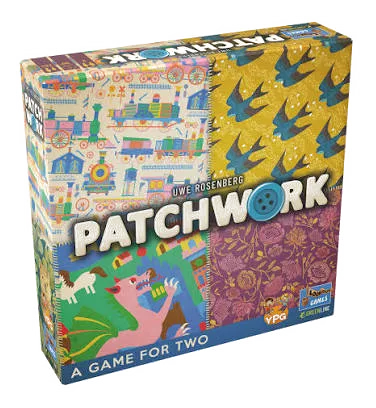
In Patchwork, two players compete to build the most aesthetic (and high-scoring) patchwork quilt on a personal 9x9 game board. To start play, lay out all of the patches at random in a circle and place a marker directly clockwise of the 2-1 patch. Each player takes five buttons — the currency/points in the game — and someone is chosen as the start player. On a turn, a player either purchases one of the three patches standing clockwise of the spool or passes. To purchase a patch, you pay the cost in buttons shown on the patch, move the spool to that patch's location in the circle, add the patch to your game board, then advance your time token on the time track a number of spaces equal to the time shown on the patch. You're free to place the patch anywhere on your board that doesn't overlap other patches, but you probably want to fit things together as tightly as possible. If your time token is behind or on top of the other player's time token, then you take another turn; otherwise the opponent now goes. Instead of purchasing a patch, you can choose to pass; to do this, you move your time token to the space immediately in front of the opponent's time token, then take one button from the bank for each space you moved. In addition to a button cost and time cost, each patch also features 0-3 buttons, and when you move your time token past a button on the time track, you earn "button income": sum the number of buttons depicted on your personal game board, then take this many buttons from the bank. What's more, the time track depicts five 1x1 patches on it, and during set-up you place five actual 1x1 patches on these spaces. Whoever first passes a patch on the time track claims this patch and immediately places it on his game board. Additionally, the first player to completely fill in a 7x7 square on his game board earns a bonus tile worth 7 extra points at the end of the game. (Of course, this doesn't happen in every game.) When a player takes an action that moves his time token to the central square of the time track, he takes one final button income from the bank. Once both players are in the center, the game ends and scoring takes place. Each player scores one point per button in his possession, then loses two points for each empty square on his game board. Scores can be negative. The player with the most points wins.