Overview
At a glance
Is this game right for my group?
ABG editorial scores on a 1–5 scale.
Harder to teach
High replayability
Highly interactive
Scales well
Deep strategy
How it plays
How does it play?
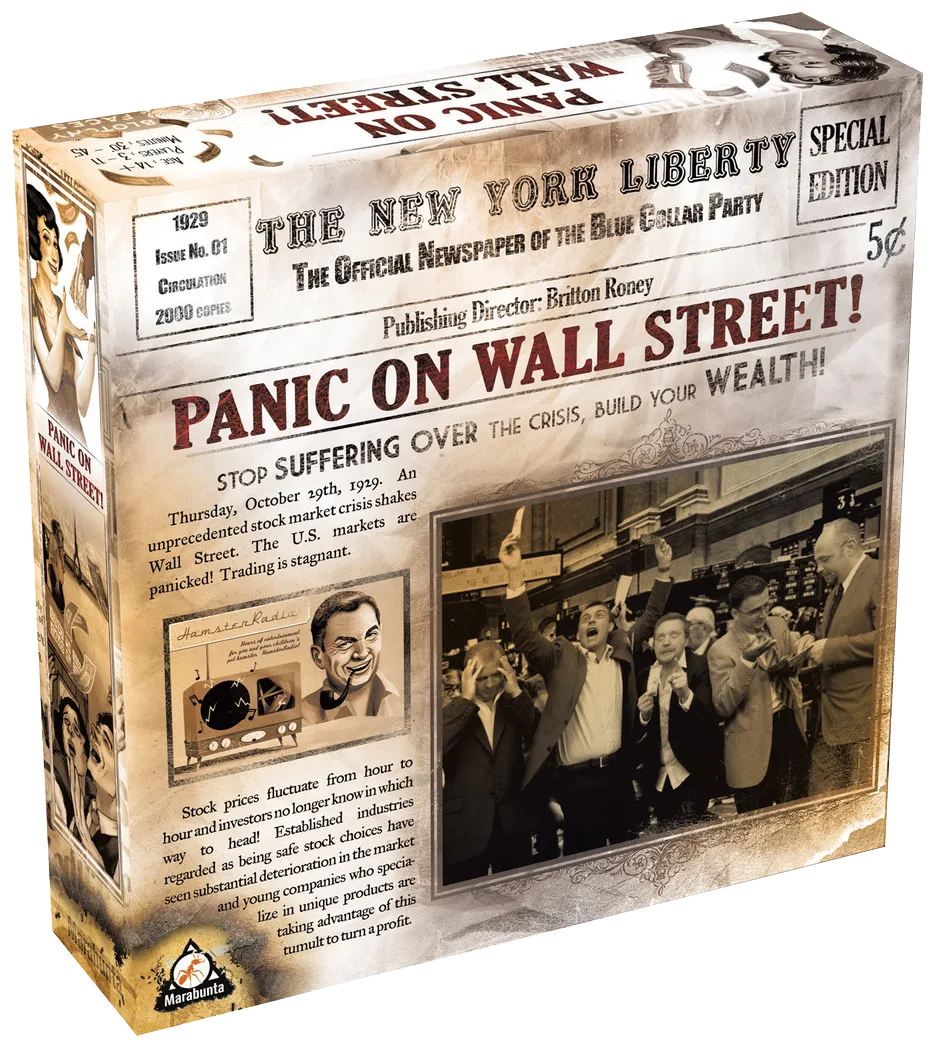
In Panic on Wall Street! you take on the role of a freewheeling capitalist out to outmaneuver your competitors and earn your place as a great industrialist.
Core mechanisms
Key systems that shape the decisions players make.
Auction/Bidding
Bid against other players to determine who receives an item, action, or priority.
Commodity Speculation
Buy or influence goods whose values change before they are sold or scored.
Dice Rolling
Roll dice to introduce uncertainty into actions, production, movement, or resolution.
Stock Holding
Acquire shares whose value depends on companies, assets, or player actions.
Player Elimination
Players can be removed from contention before the game ends.
Read the full game description
In Panic on Wall Street! you take on the role of a freewheeling capitalist out to outmaneuver your competitors and earn your place as a great industrialist. Players are divided into managers and investors. Your goal is to earn more money than any other manager (if you are a manager) or more money than any other investor (if you are a investor) by the end of the fifth round. Each round managers and investors negotiate with each other in a noisy, two-minute free-for-all to set a purchase price for shares in the managers' companies. Investors then collect income from the shares they purchased but not until a roll of the dice brings (sometimes drastic) changes to the economy, with major consequences for the balance sheet of each player. Managers collect what they are owed from investors, pay fees for each of their companies, and buy new companies at auction. After five rounds of play (5 months), the manager and the investor who have accumulated the most money are each declared victors, the undisputed masters of commerce. Panic on Wall Street! is the new edition of Masters of Commerce. See 'More Information' below for differences between the two editions.