Overview
At a glance
Is this game right for my group?
ABG editorial scores on a 1–5 scale.
Harder to teach
High replayability
Highly interactive
Scales well
Deep strategy
How it plays
How does it play?
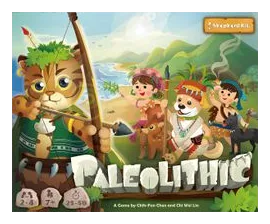
Paleolithic is a an entry level worker placement game with the pace designed for children from 7 and older with game strategies for them to gradually build up and acquire.
Core mechanisms
Key systems that shape the decisions players make.
Read the full game description
Paleolithic is a an entry level worker placement game with the pace designed for children from 7 and older with game strategies for them to gradually build up and acquire. In Paleolithic, players act as elders from local tribes, trying to form a unique civilization through migration, resource gathering, and tribal establishment. Bring along your tribal fellows and animal companions, and claim your land from the primal island of Formosa to become the great elder! Each player starts the game with two caveman tokens and one animal companion, with these being placed depending on the culture they represent in the game. In each round, players can choose to explore, produce artifacts, or build tribes as follows: Explore: First, optionally move one caveman or animal token to an adjacent ring, then roll a die; any ring occupied by a player's caveman or animal token generates resources based on the "dice points + number of tokens" corresponding to the list of resources next to the occupied ring. Produce artifacts: Discard the corresponding resources to acquire the artifact card, which has a point value depicted on it. Build Tribes: Discard resources to acquire a tile, and place a tribal token on the map; each tribal tile is worth 3 points at the end of the game, and it counts as a player token for resource generation. Once any player has obtained a total of eight artifact cards and tribal tiles, the game ends, then players tally points for tribal tiles, artifact cards, and artifact combinations shown on a player's culture board.