Overview
At a glance
Is this game right for my group?
ABG editorial scores on a 1–5 scale.
Harder to teach
High replayability
Highly interactive
Scales well
Deep strategy
How it plays
How does it play?
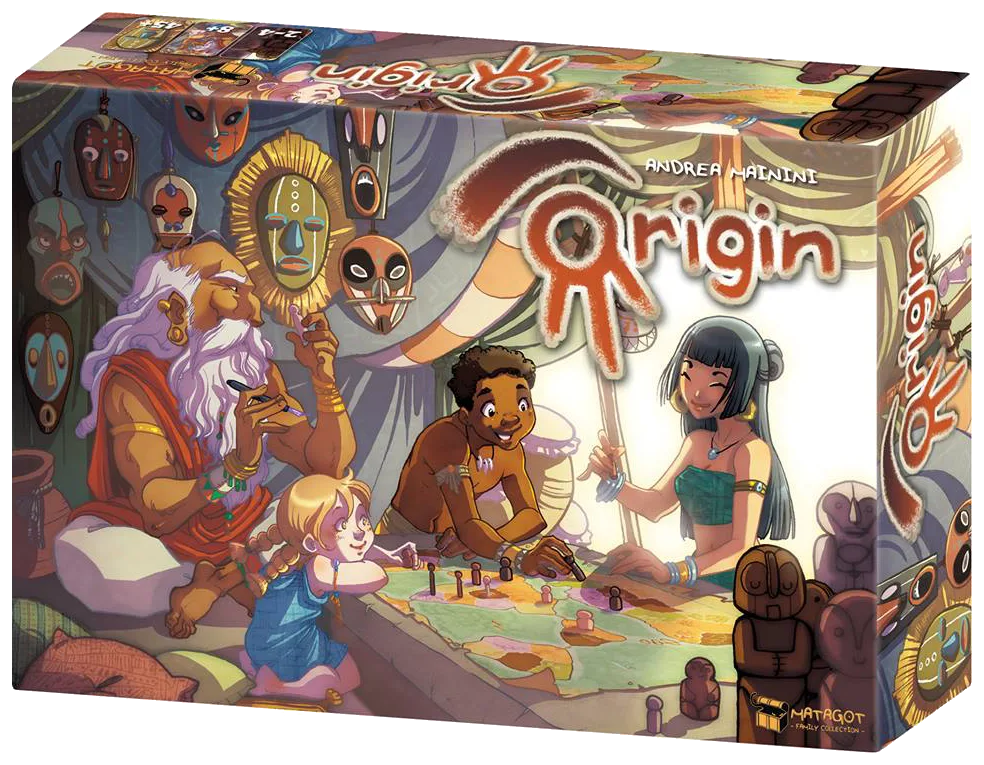
Starting from the heart of Africa, players in Origin will determine the course of mankind's expansion on our planet, with the tribes gradually growing more diversified over time while still maintaining links to their ancestors and to all inhabitants of Earth.
Core mechanisms
Key systems that shape the decisions players make.
Area Majority
Compete to have the strongest presence in areas that award control or points.
Area Movement
Move pieces between connected regions rather than along individual spaces.
Hand Management
Time and sequence a limited hand of cards to preserve future options.
Set Collection
Gather related items that become more valuable when scored together.
Read the full game description
Starting from the heart of Africa, players in Origin will determine the course of mankind's expansion on our planet, with the tribes gradually growing more diversified over time while still maintaining links to their ancestors and to all inhabitants of Earth. The game tokens in Origin come in three colors, three heights, and three thicknesses, and at the start of the game one of the smallest, skinniest pieces is placed in the center of Africa. In addition, you place three technology tiles at random on the tan, orange and violet sections of the tech chart and six random tiles on the brown section; the tech tiles show 1-5 arrows. You also shuffle tan, orange and violet decks of cards and place them in the appropriate places. Tan cards provide an one-shot effect, orange cards give you a permanent power, and violet cards present you with an objective you must meet; if you do so, you can play the objective card on your turn, and immediately draw another. You can play at most one card of each color each turn. On a turn, a player takes one of three actions: Place a new piece on a region of the game board, with this piece sharing two of the three characteristics of a piece in a neighboring region; the new piece cannot be shorter than the original piece. Mark this piece with a token of your player color. Move one of your pieces on the board to an empty region, with short pieces moving only one space, medium height pieces moving up to two spaces, and tall pieces up to three. Take over a region controlled by an opponent by moving one of your pieces into this region and relocating the opponent's piece to the region your piece left. You can do this only if the attacking piece is thicker than the opponent's piece. When you place a new piece on the board or move an existing piece, you're rewarded based on the color of the space you occupy. If you place in or move into a tan, orange or violet region, either you take a tile and the top card of this color or you draw three cards of this color and keep one of them. For a brown region, you either draw two tiles from the brown section of the tech board or draw one tile from anywhere. The technology tiles must be acquired from low to high – so you can't acquire a 4 unless you have a 3 – but you can have multiple tech stacks. You must meet a certain technology threshold in order to play the orange cards and acquire their special power. In addition, you can score points during the game by occupying a grassland on a continent or the two regions on opposite sides of a waterway strait. Players take turns until either all of the pieces are on the game board or all the tiles have been acquired or all the cards of one color have been drawn. Once this happens, players tally their points for objectives, grasslands, straits, tech tiles, and cards still in hand to see who wins!