Overview
At a glance
Is this game right for my group?
ABG editorial scores on a 1–5 scale.
Harder to teach
High replayability
Highly interactive
Scales well
Deep strategy
How it plays
How does it play?
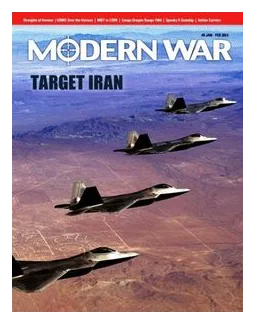
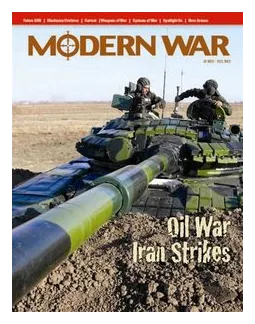
This near-future what-if wargame, designed by Ty Bomba, is an update and expansion of the classic old-SPI Oil War game from the mid-1970s. It has been released on the magazine Modern War.
Core mechanisms
Key systems that shape the decisions players make.
Read the full game description
This near-future what-if wargame, designed by Ty Bomba, is an update and expansion of the classic old-SPI Oil War game from the mid-1970s. It has been released on the magazine Modern War. It examines an Iranian strategic alternative that’s becoming increasingly plausible in light of the draw down of US military strength in the Middle East. That is, just as it did in Cold War Europe, the prospect of both sides having nuclear weapons in this “zone of confrontation” may work to create a deterrent umbrella that, at least for some time, could allow for a potentially decisive conventional war to go on underneath the threat of “mutually assured destruction.” Oil War: Iran Strikes (OW) is a low-intermediate complexity design set in a timeframe of the near future – 2013 through 2017 – in which the Iranians may indeed have developed some kind of nuclear capability. At that same time, with the “War on Terror” having likely slithered to an indecisive end by then, and the US therefore likely fallen back into another post-Vietnam-type “neo-isolationist” phase, the possibility for a blitz-style Iranian conventional military victory – aimed at establishing and certifying Tehran as the hegemon of the Gulf region – moves to the fore. OW examines the strategic and operational possibilities and parameters inherent in the opening Iranian offensive of such a war. There are no rules for the use of atomic bombs or other weapons of mass destruction (WMD). The situation is on such a hair trigger in regard to that aspect of things, if one such weapon were to go off, many more detonations would be certain to follow. The idea is for Iran to gain a victory without resorting to “game changing” WMD. Each hex on the map equals 18 miles (30 km) from side to opposite side, and its coverage stretches from Turkey in the north to the UAE in the south, and from the Iranian border and Persian Gulf on the east to Baghdad and Riyadh on the west. Each game turn represents three days, with a full match covering the first month of the war. Units of maneuver are corps, divisions, brigades, and US brigade combat teams (BCT) of various kinds, each containing from about 5,000 to 15,000 men and/or 50 to 400 armored fighting vehicles or helicopters. The most up-to-date data available have been used to establish each participant country’s detailed order or battle, including the Iranian regular army (Artesh), Basij (martyr force) and Revolutionary Guards, along with the ground forces of Iraq (loyalist and insurgent militias and regulars, Kurds, and the “elite” Quick Reaction Force). There are also the armies of Kuwait, Saudi Arabia, Qatar, Bahrain, the UAE, Syria, Turkey and, of course, the US. Special rules cover such things as: sudden death victories and victories on points, variable phase sequences, US naval supremacy, unique Saudi combat5 characteristics, geographic and multi-national movement and combat restrictions, US locking zones of control, US bases, Kuwaiti border defenses, Iraqi unit defections, Al Qods terror attacks, massed Basij suicide attacks, Basra’s critical logistical status, Iranian airborne and marine units, artillery, combat engineers, airpower, UN intervention, unique US BCT capabilities, the legend of the 12th Imam, and much more.