Overview
At a glance
Is this game right for my group?
ABG editorial scores on a 1–5 scale.
Harder to teach
High replayability
Highly interactive
Scales well
Deep strategy
How it plays
How does it play?
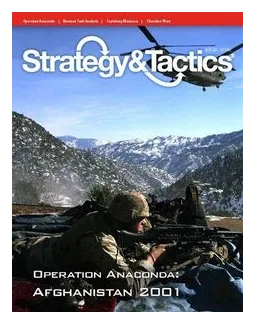
From the publisher' website: Operation Anaconda, the battle fought between Coalition forces and Al Qaeda in eastern Afghanistan in March of 2002.
Core mechanisms
Key systems that shape the decisions players make.
Read the full game description
From the publisher' website: Operation Anaconda, the battle fought between Coalition forces and Al Qaeda in eastern Afghanistan in March of 2002. This battle was a combined US-Afghan-Coalition force attempt to surround and destroy Al Qaeda forces, but the operation fell apart owing to poor command control. While technically a Coalition victory, the battle demonstrated the strengths and weaknesses of both sides. The game system is based on the "Boots" system, which makes command-control the central feature of the design. Each player commands a combat force composed of one or more sub-commands. These sub-commands are maneuvered via picking Command Chits at random; When a Command Chit is picked, that sub-command is then activated. Since players do not know the order in which those Command Chits are picked, battles become chaotic fights as players strive to create and exploit opportunities. This is a two-player game, with one player commanding Coalition forces, and the other Al Qaeda. Combat in the game is quasi-tactical. Units fire at enemy targets at range. Additionally, the Coalition player has access to various types of fire support, such as airstrikes. However, owing to the chaotic nature of the battle, fire support as well as various reinforcements appear at random. The Al Qaeda player has the advantage of his units being deployed face down so that the Coalition player must use ISR (Intelligence-Surveillance-Reconnaissance) to reveal them. Game play becomes a tense contest between asymmetrical forces in the mountains of Afghanistan.