Table feel
Numeri has a moderate level of direct confrontation and strategic depth in confrontation. Players need to frequently pay attention to and react to others' strategies and turns. However, there is less emphasis on cooperation in the game.
Players
2-4
Time
?-?
Age
7+
Weight
1.4
Rating
5.66
Teaching signal
High replayability
Highly interactive
Scales well
Deep strategy
Luck-sensitive
Numeri has a moderate level of direct confrontation and strategic depth in confrontation. Players need to frequently pay attention to and react to others' strategies and turns. However, there is less emphasis on cooperation in the game.
Numeri has a high variability gameboard, with multiple paths to victory and variable setups. The presence of expansions adds new content and gameplay elements, enhancing replay value. The game offers deep strategic possibilities and room for improvement over time. The player interaction score is moderate. Numeri scales well with different numbers of players without compromising its appeal or balance. It is moderately easy to learn, offering a good balance between depth and accessibility. Overall, Numeri has a strong replayability score of 7.76.
Numeri has a moderate level of luck involved in the game. Random elements such as dice rolls or card draws have a notable but not exclusive impact on the game outcome. Players have some ability to influence or mitigate the effects of randomness through strategic decisions and planning. The game outcome is a balanced mix of luck and strategy, with neither element dominating. Overall, Numeri provides a good balance between luck and player decisions, making it an engaging and strategic board game.
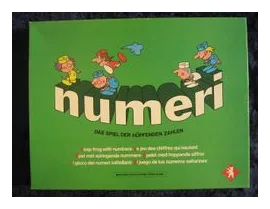
Each player receives six figures of the same color, numbered from 1 to six. The number on the dice signifies the figures to be played. A player must move figures totaling to the amount shown. If he rolls a six he can move as an example pawn number 2 and pawn number 4. They always move to the next free space that is available on the board. If the player succeeds in making a chain - that means 3 or more pawns in a row he rolls the dice again. The game is finished when the last three, specially marked squares are occupied. Each player receives the number of points achieved by multiplying the number of the square by the number of the occupying pawn. Re-implemented by: Moon Leap
No media imported yet.
| Edition | Year | Language | Publisher / Region |
|---|---|---|---|
| No editions imported yet. | |||
No files imported yet.
No commerce mappings imported yet.