Overview
At a glance
Is this game right for my group?
ABG editorial scores on a 1–5 scale.
Harder to teach
High replayability
Highly interactive
Scales well
Deep strategy
How it plays
How does it play?
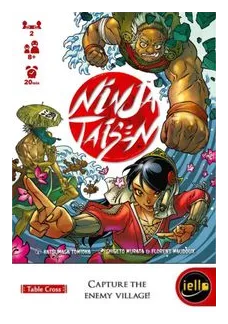
Ninja Taisen is a two-player, dice-driven open information abstract game with a random set-up.
Core mechanisms
Key systems that shape the decisions players make.
Read the full game description
Ninja Taisen is a two-player, dice-driven open information abstract game with a random set-up. Both players have identical sets of ten fighters, with three fighters in each of three colors with values 1–3 along with a tri-colored boss valued at 4; these fighters are placed in small stacks of varying size onto a line that's eleven steps long. On a player's turn, he rolls the three colored dice and can make up to three moves accordingly, with the blue die moving a blue fighter, etc. Moving a fighter that has other fighters on top of him moves these other fighters as well. If, as a result of movement, his fighter (or stack of fighters) encounters an enemy, a fight between the two top cards in each stack occurs, the result of which is decided primarily by the color (via a rock-paper-scissors mechanism) and secondarily by the number (highest wins). If the boss wins a fight, its power is reduced by the enemy's power for the remainder of the current fight; if two fighters draw, they both retreat one step toward their own village, possibly precipitating other fights on the same turn. The fight continues until either pile is depleted. The first player to either defeat all of the opposing fighters or reach the end of the line (and clear out the opponent's fighters in his village) wins.