Overview
At a glance
Is this game right for my group?
ABG editorial scores on a 1–5 scale.
Harder to teach
High replayability
Highly interactive
Scales well
Deep strategy
How it plays
How does it play?
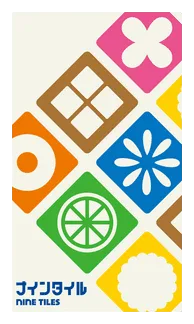
In Nine Tiles, each player takes nine double-sided tiles, with each side of a tile having one of six images, and arranges them in a 3x3 gird. Each image appears a total of three times on the tiles, with it being paired with a different image in each of the three instances.
Core mechanisms
Key systems that shape the decisions players make.
Pattern Building
Place elements to create arrangements that satisfy scoring or action patterns.
Pattern Recognition
Identify recurring visual, spatial, or logical arrangements.
Tile Placement
Place tiles to build a shared or personal spatial arrangement.
Player Elimination
Players can be removed from contention before the game ends.
Read the full game description
In Nine Tiles, each player takes nine double-sided tiles, with each side of a tile having one of six images, and arranges them in a 3x3 gird. Each image appears a total of three times on the tiles, with it being paired with a different image in each of the three instances. (The sets of nine tiles are identical, and they have 1-4 dots on them to help players sort the tiles.) Each round, one of the thirty goal cards is revealed, then players race to rearrange their tiles — flipping one tile at a time, or swapping two tiles — in order to make their nine tiles match the image shown on the card. Whenever a player thinks they've done this, they slap the card. If they're correct, they keep the card; if they're wrong, they still keep the card, but flipped face-down. If a player collect two face-down cards, they're out of the game. The first play to collect four (face-up) cards wins! By combining two sets of Nine Tiles, up to eight players can compete at once. When more than four people are in a game, reveal two of the thirty cards each round. Each player can claim at most one card in a round.