Overview
At a glance
Is this game right for my group?
ABG editorial scores on a 1–5 scale.
Harder to teach
High replayability
Highly interactive
Scales well
Deep strategy
How it plays
How does it play?
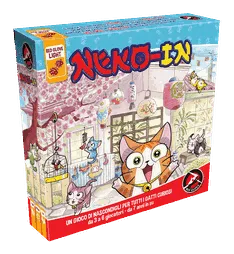
Neko-In is a game for 3-6 players lasting about 15-20 minutes, in which we will try to find lovely and gummy colored kittens (“neko” in Japanese) hidden in the remote corners of a typical house of Japan.
Core mechanisms
Key systems that shape the decisions players make.
Simultaneous Action Selection
Choose actions secretly or concurrently before revealing them together.
Area Movement
Move pieces between connected regions rather than along individual spaces.
Dice Rolling
Roll dice to introduce uncertainty into actions, production, movement, or resolution.
Take That
Direct negative effects at selected opponents.
Read the full game description
Neko-In is a game for 3-6 players lasting about 15-20 minutes, in which we will try to find lovely and gummy colored kittens (“neko” in Japanese) hidden in the remote corners of a typical house of Japan. The first player who will dug out the little animals from their possible hideouts will be the winner. You need a bit of strategy and a speedy hand. First players receive a room each. On the room boards there are 5 empty spaces for the "Hideouts". Players receive randomly 5 hideout counters each and place them “covered” in front of them. Finally all kittens are placed in the garden which is in the center of the table. The goal of the game is to get rid of all the hideout counters before your opponents. Each counter should be placed on its appropriate slot, according to the shape and color of the room. How to do it? Each turn a player move his own cat (the one corresponding to the color of his room’s frame) and according to the his counters he chooses the room where hiding the cat. If he chooses his own room then he can place the cat on any slot of his choice. But if he chooses to move his cat to a room controlled by an opponent, it’s up to the owner to choose where to place it. When your cat is placed on a slot that corresponds to one of your hideout counters (according to the shape and color of the room), discover it and place it on the corresponding position; but remember, each room cannot host more than one cat because they are not willing to share a territory. If you place your cat on a board occupied by another cat, the brawl starts. After this phase starts the “Housekeeper moment“. The current player rolls a die. All players compete to grab the matching colored kitten, wherever it is. The fastest hand moves the caught kitten to the garden and pass one of his remained counters, of his choice, to the player with less counters. If there are 2 or more opponents with the same number of counters left, he can choose the target. However he can never pass his last counter, which must necessarily be placed on the appropriate slot. The first player that remains with no hideout counters is the winner.