Table feel
Moderate level of direct confrontation and strategic depth, with frequent interaction and limited emphasis on cooperation.
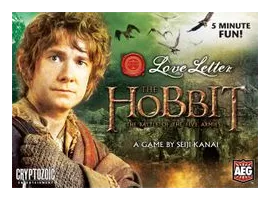
Love Letter: The Hobbit – The Battle of the Five Armies is a game of risk, deduction, and luck for 2–4 players based on the original Love Letter game by Seiji Kanai. The deck consists of 17 cards, with the Arkenstone being valued #8, Bilbo Baggins #7, and so on down to The One Ri...
Players
2-4
Time
20-30
Age
8+
Weight
1.27
Rating
7.12
Should this hit the table?
Moderate level of direct confrontation and strategic depth, with frequent interaction and limited emphasis on cooperation.
Teaching signal
High replayability
Highly interactive
Scales well
Deep strategy
Luck-sensitive
Moderate level of direct confrontation and strategic depth, with frequent interaction and limited emphasis on cooperation.
Love Letter: The Hobbit - The Battle of the Five Armies has a high replayability score due to its strong variability, strategic depth, and adaptability to different player counts. The game offers different experiences each time it is played, with expansions adding new content and gameplay elements. Players can continuously improve their strategy over time, and the game remains engaging regardless of group size. While it may take some time to learn, the depth it offers makes it worth the investment.
The final luck score for Love Letter: The Hobbit - The Battle of the Five Armies is 6, indicating a balanced mix of luck and strategy. The game outcome is influenced by both random elements and player decisions. While random elements like card draws play a significant role, players have substantial ability to mitigate luck through strategic decisions and planning. Overall, luck is moderately important in this game, but player strategy also plays a significant role in determining the outcome.
Overview
Love Letter: The Hobbit – The Battle of the Five Armies is a game of risk, deduction, and luck for 2–4 players based on the original Love Letter game by Seiji Kanai. The deck consists of 17 cards, with the Arkenstone being valued #8, Bilbo Baggins #7, and so on down to The One Ring at #0. In each round, each player starts with only one card in hand; one card is removed from play. On a turn, you draw one card, and play one card, using the power on that card to expose others and (possibly) knock them out of the round. If you're the final player active in the round or the player with the highest card when the deck runs out, then you score a point. In LL: The Hobbit, The One Ring does nothing during play, but it counts as a #7 when the game ends, possibly leading to a tie should someone else hold Bilbo. In addition to the one extra card, LL: The Hobbit differs from the original game in that the Baron (#3) is represented by two separate cards: Tauriel and Legolas. When you use an elf's power to compare cards, Tauriel knocks out the player with the higher valued card while Legolas targets the lower valued card. (This change isn't in the German edition, where Legolas and Tauriel have the same text.) Whoever first wins 4-7 rounds, with the number dependent on the number of players, wins the game!
Media
Images, galleries, and videos are grouped here so the page feels visual before every asset is fully hosted.
Editions
| Edition | Year | Language | Publisher / Region |
|---|---|---|---|
| No editions imported yet. | |||
Files and documents
No files imported yet.
Commerce mapping
No commerce mappings imported yet.
Credits
Linked items
Related games and expansions help build a connected catalog around every title.
No linked items imported yet.