Overview
At a glance
Is this game right for my group?
ABG editorial scores on a 1–5 scale.
Harder to teach
High replayability
Highly interactive
Scales well
Deep strategy
How it plays
How does it play?
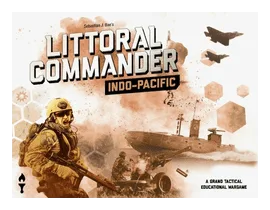
Littoral Commander (formerly Fleet Marine Force) is a 2-6 player boardgame about potential military conflict in the Indo-Pacific region, a hybrid of standard hex and counter wargames and card-driven games.
Core mechanisms
Key systems that shape the decisions players make.
Command Cards
Use cards to issue orders and determine which units or actions can activate.
Hand Management
Time and sequence a limited hand of cards to preserve future options.
Asymmetric Roles
Different roles know different information and contribute in different ways.
Hexagon Grid
Use a hexagonal map where each space connects evenly in six directions.
Zone of Control
Restrict or influence movement through areas controlled by nearby pieces.
Read the full game description
Littoral Commander (formerly Fleet Marine Force) is a 2-6 player boardgame about potential military conflict in the Indo-Pacific region, a hybrid of standard hex and counter wargames and card-driven games. Players spend Action Points (AP) during their turn to activate cards or move units on the game board. The game was originally designed for professional military education, but has been adapted for commercial release. The units in the game represent current and future project capabilities for the US Marine Corps / US Navy and the Chinese Navy and Marine Corps (PLAN/PLANMC). The gameplay emphasizes coordination within teams to successfully find and engage the enemy through both kinetic (like missiles) and non-kinetic (like cyber) means. Over 200+ Joint Capability Cards (JCCs) represent a wide range of joint and adversary capabilities. This includes cyber-attacks, influence operations, bomber strikes, submarines, key enablers, and more. The system highlights the importance of reconnaissance, long-range strike, logistics, and cyber capabilities in modern combat. It is designed as an accessible and modular system for both experienced and new players. The game features a scenario system, where players can play on four different maps: Luzon, Taiwan, Straits of Malacca, and Okinawa. Players can play one of the baseline scenarios provided, but are also encouraged to adapt and create their own scenarios for the game. —description from the designer