Overview
At a glance
Is this game right for my group?
ABG editorial scores on a 1–5 scale.
Harder to teach
High replayability
Low interaction
Scales well
Deep strategy
How it plays
How does it play?
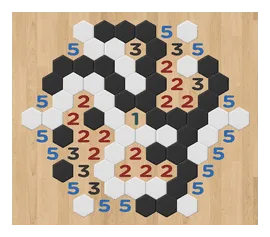
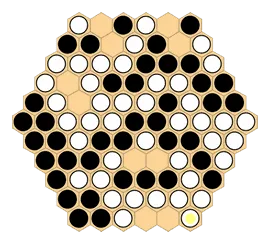
Lifeline is a territorial strategy game for two players (Black and White) that is played on the cells of an initially empty hexhex board. The recommended board sizes are between 3 and 12 cells per side.
Core mechanisms
Key systems that shape the decisions players make.
Chaining
Link actions or effects so one result enables the next part of a sequence.
Enclosure
Surround spaces or pieces to claim territory, capture, or score.
Pattern Building
Place elements to create arrangements that satisfy scoring or action patterns.
Tile Placement
Place tiles to build a shared or personal spatial arrangement.
Pattern Recognition
Identify recurring visual, spatial, or logical arrangements.
Hexagon Grid
Use a hexagonal map where each space connects evenly in six directions.
Read the full game description
Lifeline is a territorial strategy game for two players (Black and White) that is played on the cells of an initially empty hexhex board. The recommended board sizes are between 3 and 12 cells per side. The game was invented by Michael Amundsen and Luis Bolaños Mures. Although inspired by Go, it bears a significant resemblance to Kanare Kato's Meridians. DefinitionsA group is an entire set of connected stones of the same color. A single stone, not connected to others of its color, is also a group. A group is dead if there is no path of connected empty cells between that group and any other group of its color. The path does not need to be a straight line. PlayBlack plays first, then turns alternate. On your turn, perform the following actions in order: Place a stone of your color on an empty cell. If it is your first turn of the game, perform this action twice. Remove all dead enemy groups. Remove all dead friendly groups. The board positions at the start and at the end of your turn must be different. In other words, if the only stone you remove is the one you just placed, your placement is illegal. The last player to make a placement wins. Note that, after your first turn, you will always have a placement available unless you have no groups on the board. To make the game fair, White will have the option, on their first turn only, to swap sides with Black instead of making a regular move. VariantsThe standard game is made fair by the combination of the double first move and White's swap option, as described above. This balancing method is called strong pie. Some alternatives are: Weak pie: Instead of placing twice on their first turn, players place one stone on every turn, and dead groups are not removed until there are at least four stones on the board. White's swap option still applies, but takes place after Black has placed only one stone. Komi pie: Before the game starts, the first player chooses a whole number as the komi value, and then the second player chooses sides. The first four stones are placed in the same manner as with weak pie, but there is no swap option after Black's fist placement. Throughout the game proper, White will have the option to spend a point of komi instead of making a placement. Unlike strong pie, these methods require somewhat large boards to be effective: at least base 6 for weak pie, and at least base 7 for komi pie. —description from the designers