Overview
At a glance
Is this game right for my group?
ABG editorial scores on a 1–5 scale.
Harder to teach
High replayability
Highly interactive
Scales well
Deep strategy
How it plays
How does it play?
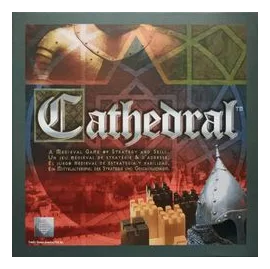
In Cathedral, each player has a set of pieces of a different color. The pieces are in the shapes of buildings, covering from one to five square units.
Core mechanisms
Key systems that shape the decisions players make.
Pattern Building
Place elements to create arrangements that satisfy scoring or action patterns.
Enclosure
Surround spaces or pieces to claim territory, capture, or score.
Tile Placement
Place tiles to build a shared or personal spatial arrangement.
Pattern Recognition
Identify recurring visual, spatial, or logical arrangements.
Square Grid
Use an orthogonal grid where position and adjacent spaces shape movement or placement.
Read the full game description
In Cathedral, each player has a set of pieces of a different color. The pieces are in the shapes of buildings, covering from one to five square units. The first player takes the single neutral Cathedral piece and places it onto the board. Players then alternate placing one of their buildings onto the board until neither player can place another building. Players capture territory by surrounding areas that are occupied by at most one opponent or neutral building. A captured piece is removed and captured territory becomes off-limits to the opponent. The player with the fewest 'square units' of buildings that can't be placed wins.