Overview
At a glance
Is this game right for my group?
ABG editorial scores on a 1–5 scale.
Harder to teach
High replayability
Highly interactive
Scales well
Deep strategy
How it plays
How does it play?
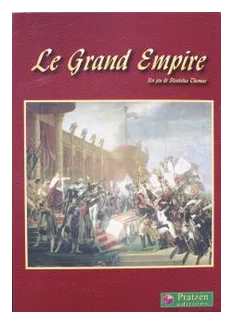
Le Grand Empire simulates the Napoleonic wars from 1800 to 1815 at a strategic level. Two maps cover Europe and North Africa from Caucasus to Ireland and from Sweden to Egypt.
Core mechanisms
Key systems that shape the decisions players make.
Read the full game description
Le Grand Empire simulates the Napoleonic wars from 1800 to 1815 at a strategic level. Two maps cover Europe and North Africa from Caucasus to Ireland and from Sweden to Egypt. 780 counters personify land and naval units as well as every corps-commanding leader of that time. The combat units are army corps and fleets, and sometimes entire armies. Their content varies with the player’s will and the contingencies of that era; Guard, line infantry, Elite, light cavalry, heavy cavalry, militia, Cossacks, and so on. The game turns are season-based and interactive, including a variable number of impulses. A budget phase occurs every fall. The game can involve two players (one French and one anti-French), or five players (France, Great-Britain, Prussia, Russia and Austria), or even seven players (Spain and the Ottoman Empire have their own player). Of course, victory conditions vary accordingly. The operational part of the game points out the importance of leadership and line of communication; attrition can be very high. Evasive actions and interceptions lead to the deployment of armies followed by battle. Battle occurs in the same hex; troop quality, tactical choices and leader values are taken into account in the issue of the battle. At the strategic level, the players are responsible for their unit’s production and maintenance. Diplomacy is the key point in creating alliances with other powers, major or minor. Moreover, many random events improve the Napoleonic flavor of that time. The overall purpose of the Grand Empire is to provide a strategic Napoleonic game that takes into account historical, military and diplomatic sights, and that can be played in a short period of time (one year is four turns and can be played in two hours) with a reasonable amount of rules. Contents : * Two maps * 3 countersheets (260 double sided counters each). * one rulebook and one scenarios booklet. * 2 dice. * Tables and charts