Overview
At a glance
Is this game right for my group?
ABG editorial scores on a 1–5 scale.
Harder to teach
High replayability
Highly interactive
Scales well
Deep strategy
How it plays
How does it play?
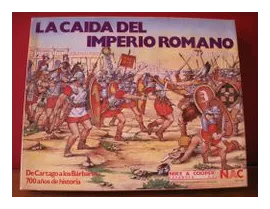
"La Caída del Imperio Romano" (The Fall of the Roman Empire) is a strategic simulation of the events and conflicts that led the Romans to subdue the neighbor civilizations and create a vast empire throughout Europe, Africa and Asia Minor.
Core mechanisms
Key systems that shape the decisions players make.
Read the full game description
"La Caída del Imperio Romano" (The Fall of the Roman Empire) is a strategic simulation of the events and conflicts that led the Romans to subdue the neighbor civilizations and create a vast empire throughout Europe, Africa and Asia Minor. Two different games may be played: - an 8-turns basic game focusing on the Punic wars. - a 20-turns advanced game covering the 7-centuries period that saw the rise and fall of Rome. The game is played by 2-4 players. Whenever 4 players are involved, two of them control the Western and Eastern Roman Empire, respectively, whereas the third plays the role of Carthage and the last player controls the Greeks, Egyptians, Persians, Barbarians and other minor people. Players move their troops (hex-based), resolve combats, build and fortify cities, and either negotiate or conquer the weakest neighbor. Any player getting the surrender or complete annihilation of enemies’ forces is considered the winner of the game. The Roman player wins whether he keeps 30 cities, at any time, or at least 20 cities at the end of the 20th turn. Otherwise, the winners are the Carthaginians or even these along with the Barbarian people. Game components: - One 80x64 cm map covering the Mediterranean basin, North Africa and Asia Minor - 480 counters (armies and leaders, ships, cities, fortified cities, Barbarian invaders, etc.) - A 15-pages rulebook - One die