Overview
At a glance
Is this game right for my group?
ABG editorial scores on a 1–5 scale.
Harder to teach
High replayability
Highly interactive
Scales well
Deep strategy
How it plays
How does it play?
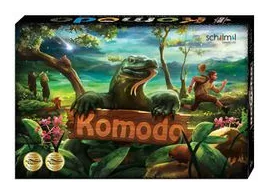
In the strategic tile-laying game Komodo, players are zoologists attempting to build new habitats for Australasian animals imperilled by an incoming asteroid.
Core mechanisms
Key systems that shape the decisions players make.
Open Drafting
Select cards or items from a shared face-up display.
Modular Board
Build the play area from interchangeable sections that vary between games.
Cooperative Game
Players coordinate their actions toward a shared objective and win or lose together.
Hand Management
Time and sequence a limited hand of cards to preserve future options.
Tile Placement
Place tiles to build a shared or personal spatial arrangement.
Read the full game description
In the strategic tile-laying game Komodo, players are zoologists attempting to build new habitats for Australasian animals imperilled by an incoming asteroid. Each player holds two animal cards stating the type and amount of terrain needed, five multi-terrain tiles, and wild cards. On a turn, they may lay up to three tiles, place one or both of their animals in free-form contiguous blocks of appropriate terrain, and use all or some of their wild cards. The starter tile has two blocks of each of the four terrain types: forest, grassland, desert and water. The number of blocks of terrain needed by an animal is equivalent to the number of points you can score by placing it. When the tile supply is exhausted, each player takes a final turn, then loses points for any unplaced animals still in hand. The player with the highest score wins. Komodo can be played competitively in both basic or strategic mode. In the former, wild cards are obtained randomly; in the latter, players can choose their wild cards. Actions permitted by a wild card include: releasing animals to free up their terrain; bartering or stealing terrain tiles; remodeling tiles already placed; and forcing an exchange of animals. In the cooperative version of Komodo, all 32 animals must be housed and each player must place at least one animal during their turn. The game is played open-handed, and the wild cards hinder the players.