Overview
At a glance
Is this game right for my group?
ABG editorial scores on a 1–5 scale.
Harder to teach
High replayability
Low interaction
Scales well
Deep strategy
How it plays
How does it play?
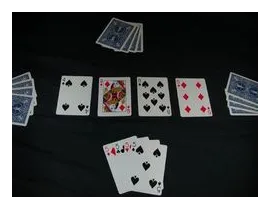
Kemps (also known as Canes) is played with two two-person teams. (You could play with three or four teams, but it becomes more complicated.) Each player is dealt a hand of 4 cards from a standard deck, and then the Dealer deals four cards face-up to the center of the table.
Core mechanisms
Key systems that shape the decisions players make.
Read the full game description
Kemps (also known as Canes) is played with two two-person teams. (You could play with three or four teams, but it becomes more complicated.) Each player is dealt a hand of 4 cards from a standard deck, and then the Dealer deals four cards face-up to the center of the table. If you're right-handed, you should keep your hand (of cards) in your left hand, and vice-versa -- this is because you are only allowed to use one hand to pick up or put down cards. When everyone is ready, the Dealer says "Begin", at which point the round starts. Play is simultaneous, with no turns. Your goal is to have all four cards in your hand of the same value (i.e. all 4 kings, or all 4 deuces). If a card you want is on the table, pick it up, put it in your hand, and then discard a card to replace it. If the action comes to a standstill because noone wants any of the cards on the table, the Dealer removes them, deals another four cards, and says "Begin" again. When you have acquired a complete set, you have Kemps, but you cannot declare this yourself. Instead, you must use a pre-arranged signal to inform your partner (which must be "over the table" -- no kicking your partner in the shins!), who then announces "Kemps". You show your hand, and your team gets a point. If you or your partner misread the signal and call Kemps erroneously, the other team gets a point. If you think you have spotted the other team's signal, you can call "Kemps against", and name the player you think has Kemps. If you are correct, your team gets a point, otherwise the other team does. When someone has figured out the other team's signal, that team can go somewhere private to come up with a new one. Play until any agreed-upon number of points.