Overview
At a glance
Is this game right for my group?
ABG editorial scores on a 1–5 scale.
Harder to teach
High replayability
Highly interactive
Scales well
Deep strategy
How it plays
How does it play?
Explore far-away planets. Discover what resources and surprises they hold.
Core mechanisms
Key systems that shape the decisions players make.
Read the full game description
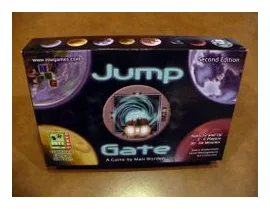
Explore far-away planets. Discover what resources and surprises they hold. Be the first to set foot on a new planet and claim it as your own. Collect resources to gain fortune and fame. All of this comes courtesy of: the Jump Gate. Players are spaceship captains that are competing to be the best at claiming new planets and collecting the resources found at those planets. Points are scored at the end of the game based on the number of planets they scanned and claimed, and their combination of resources collected. Each type of resource has a different method for being scored -- so, collecting sets of the same resource is encouraged ... and disrupting other players’ collection plans is good strategy. Gameplay Summary (1st & 2nd Editions) Eight planets are set in a circle around the Jump Gate and Black Hole Boards. Resource cards are distributed: 1 face-up to each player, 1 face-up to each planet, and the rest are distributed face-down amongst the planets. Players are each given 5 NavComp cards and the rest of the NavComp cards are set as a draw deck in the middle of the table. Each NavComp card contains 2 codes (used to take some of the standard actions) and possibly a special action. Players take turns around the table. On a player's turn, he/she takes 2 actions in any order, and may select from the following actions: Research (refill hand), Fly (move to neighboring planet), Jump (use the Jump Gate to move to another Planet), Scan (reveal a resource at a planet), Land & Claim (claim a planet and reveal all resources there), Harvest (collect a resource), and Special Action. Special actions include being able to scan a far-away planet, harvest extra resources, swap locations with another player, etc. When players "Jump", they add one of their markers to the Jump Gate Board. The player with the most markers on the Jump Gate Board at the end of the game gains an extra 5 points. If a player collects a Resource that has a "Black Hole" icon on it, a marker is added to the Black Hole Board. If too many markers get added to that board, the game ends and the player with the most markers on the Black Hole Board loses some of his/her collected Resources. The game can also end when all non-Black-Hole Resources have been collected from all of the planets. Scoring is done at the end of the game, and players are awarded points for Scanning and Claiming Planets, as well as for the combination of Resources they had collected. Each type of Resource has a different method for scoring -- but all encourage a player to collect as much of that Resource as possible. The player with the most total points is the winner. 3rd Edition Gameplay Changes The 3rd Edition, published in a smaller box with artwork and player component updates, also included a number of design changes: Max. Players is reduced to 5 New "Sand" resource replaces the "Nothing" cards from earlier editions Setup changes include giving players two or three hidden resource cards (as opposed to a single face-up card) and not every resource getting used in the game In-game changes include cleaner, more thematic scanning and harvesting rules The Black Hole only has 7 marker spaces on it, and triggering the end game via the Black Hole results in the player with the most markers on the Black Hole losing their hidden resources they received during setup instead of randomly-chosen resources No points are scored for scanning or the Jump Gate ... only the resources collected and Planets claimed