Overview
At a glance
Is this game right for my group?
ABG editorial scores on a 1–5 scale.
Harder to teach
High replayability
Highly interactive
Scales well
Deep strategy
How it plays
How does it play?
Who can collect the highest-scoring cards over three rounds of play? Will the die be on your side?
Core mechanisms
Key systems that shape the decisions players make.
Dice Rolling
Roll dice to introduce uncertainty into actions, production, movement, or resolution.
Set Collection
Gather related items that become more valuable when scored together.
Matching
Pair items with corresponding symbols, properties, or categories.
End Game Bonuses
Earn additional points for meeting conditions evaluated when the game ends.
Read the full game description
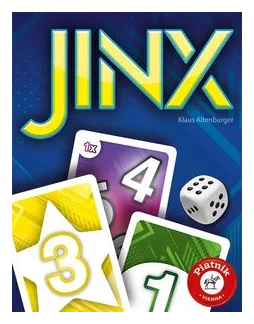
Who can collect the highest-scoring cards over three rounds of play? Will the die be on your side? Jinx is played over three rounds. At the start of each round, draw 16 cards and place them face-up; cards come in eight colors, and each color has cards numbered 1-6. On a turn, you roll the die, then optionally roll it again. After your first or second roll, you collect a card from the table that matches the number on the die. If you can't collect a card, the round ends and if the color of a card in front of you is present among the face-up cards, then you lose that card. You might lose everything depending on how jinxed you are! Players who lost a card receive a random bonus card for any remaining rounds. These cards have different powers such as adding or subtracting 1 from the die roll, rolling a third time, and choosing a card numbered 4-6 instead of rolling the die. Cards that are safe in one round might be lost in a subsequent round, so ideally you can roll well or use the bonus cards to clear out troublesome colors. At the end of three rounds, players sum the cards in front of them, and whoever has the highest score wins.