Overview
At a glance
Is this game right for my group?
ABG editorial scores on a 1–5 scale.
Harder to teach
High replayability
Highly interactive
Scales well
Deep strategy
How it plays
How does it play?
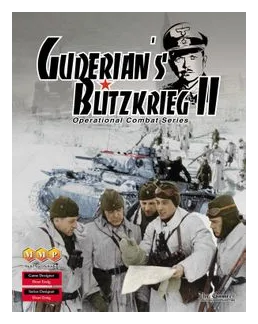
Guderian's Blitzkrieg II: Depicts the German drive to capture Moscow in the fall of 1941 (Operation Typhoon) and the first Russian Winter Counteroffensive. Army Group Center during the swing period of WW2 in the East.
Core mechanisms
Key systems that shape the decisions players make.
Read the full game description
Guderian's Blitzkrieg II: Depicts the German drive to capture Moscow in the fall of 1941 (Operation Typhoon) and the first Russian Winter Counteroffensive. Army Group Center during the swing period of WW2 in the East. This game covers the action from its popular predecessor Guderian's Blitzkrieg (1992), which led the way in Operational Combat System, and adds all the action from Lake Ilmen south to Voronezh from Oct. 41 and the last drives of Barbarossa until the Spring of 1943 and the preparations for Kursk. Not only does this game cover all the action in Army Group Center, it does this during the critical period of the war while the Russians are perfecting their operational craft. Additionally, players can try for Moscow in 1942 instead of going south to Stalingrad! They can do this either by a full-scale offensive or by using the actual German deception plan as in the real orders for 1942's Summer Campaign. Multiple scenarios allow players to explore this widely overlooked portion of the Eastern Front, to include Operation Mars. Game Scale: Game Turn: Half-week Hex: 5 miles / 8 Km Units: Battalion to Army 2011 Edition Game Inventory: Three 22 x 34" maps (Maps A, B & C) Four 14 x 22" maps (Maps D, E, F & 'Moscow Blow Up) Ten dual-side printed countersheets (2,800 1/2" counters) One 48-page OCS rules booklet One 24-page game specific rules booklet One 96-page scenario booklet One 24-page German Booklet One 24-page Russian Booklet Two 4-page Charts & Tables Player Aid Folders Two 6-sided dice 2001 Edition Game Inventory (from rulebook): 1x OCS Series Rulebook (v3.0) 1x Game Specific Rulebook 2x OCS Charts & Tables booklets 2x Dice (one red, one white) 3x 22x34” Maps 4x 22x14” Maps (includes Moscow Blowup) 2x 6.5x11” Player Aids (one Russian, one German) 2x 6.5x11” Player Aids (two identical common sheets) 10x 280-counter countersheets 1x 140-counter countersheet (from the box)