Overview
At a glance
Is this game right for my group?
ABG editorial scores on a 1–5 scale.
Harder to teach
High replayability
Highly interactive
Scales well
Deep strategy
How it plays
How does it play?
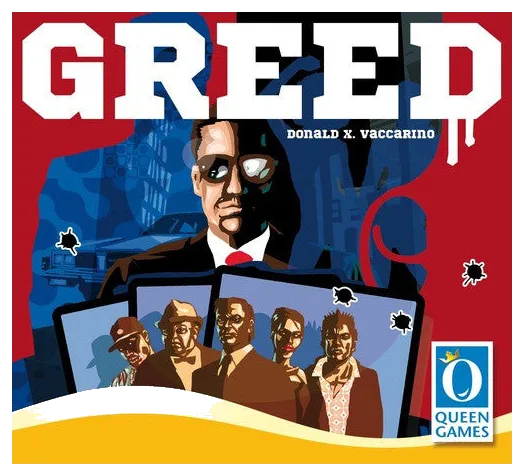
In the card game Greed, crime lords (the players) try to earn more money than anyone else through clever use of their cards. At the start of the game, each player receives a random hand of twelve cards from a deck of 80.
Core mechanisms
Key systems that shape the decisions players make.
Closed Drafting
Choose from hidden cards or items before passing or revealing the remainder.
Hand Management
Time and sequence a limited hand of cards to preserve future options.
Simultaneous Action Selection
Choose actions secretly or concurrently before revealing them together.
End Game Bonuses
Earn additional points for meeting conditions evaluated when the game ends.
Tags
Attach changing labels or properties that modify how components behave.
Read the full game description
In the card game Greed, crime lords (the players) try to earn more money than anyone else through clever use of their cards. At the start of the game, each player receives a random hand of twelve cards from a deck of 80. Players draft one card, pass the remaining cards left, draft a second card, pass again, draft a third card, pass again, then the game changes; players simultaneously choose and reveal a card, carrying out its effects, then they draft another card, pass the remaining cards, play again, and so on until ten "playing" rounds have passed, at which point the game ends and players tally their holdings. The card types are thugs, holdings and actions. Thugs and holdings might have a cost to be played (perhaps cash paid to the bank or the discarding of a holding) or a condition that you must meet (having two thugs, for example, or a collection of symbols on cards in your possession) in addition to an effect, which is unique to each card. (Each action has a unique effect as well.) When you play a holding with one or more symbols, you place a token on that card for each symbol on it and an additional token for each symbol of that type already in your possession. These tokens are worth $10k each at the end of the game, and you add this value to whatever cash you've collected through your card plays.