Overview
At a glance
Is this game right for my group?
ABG editorial scores on a 1–5 scale.
Harder to teach
High replayability
Highly interactive
Scales well
Deep strategy
How it plays
How does it play?
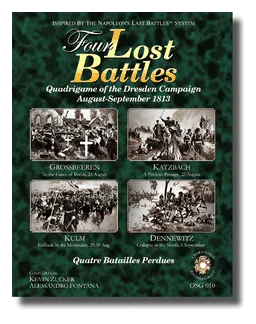
Quadrigame of the Dresden Campaign: August-September 1813.
Core mechanisms
Key systems that shape the decisions players make.
Campaign Card Play
Play cards to command conflicts and carry consequences through a campaign.
Dice Rolling
Roll dice to introduce uncertainty into actions, production, movement, or resolution.
Hexagon Grid
Use a hexagonal map where each space connects evenly in six directions.
Simulation
Model a real or imagined system through detailed cause-and-effect rules.
Read the full game description
Quadrigame of the Dresden Campaign: August-September 1813. Components: Four 22 x 17" maps and 560 two-sided units; 48 pages of rules including campaign analysis, designers notes and more; 4 player aid cards, 2 decks of cards (total of 96) used to effect deployments, arrivals, status of troops. Battles covered, GROSSBEEREN: To the Gates of Berlin, 23 August KATZBACH: A Perilous Passage, 26 August KULM: Enfilade in the Mountains, 29-30 August DENNEWITZ: Collapse in the North, 6 September After the defeats of Grossgörschen (May 2nd, 1813) and Bautzen (May 20th, 21st) the Prussian King and the Crown Prince of Sweden met at Trachenberg on July 9th. At July 12th they agreed together with Russia and (later) Austria on a Allied strategy to overhelm Napoleon by avoiding him in person on the battlefield and fight his subordinates only. After winning a great victory at Dresden early in the Autumn Campaign (August 26th/ 27th, 1813), Napoleon saw his chances for victory gradually slip away in four lost battles over a two-week period. All four battles had been fought by his subordinates, showing the effect of a "Fabian strategy". The whole campaign was over in two weeks. By Sept. 6th, a battle in or near Leipzig was certain, leading into the Battle of Nations (October 16th-19th, 1813) around Leipzig. GAME SYSTEM: Series: The Library of Napoleonic Battles (OSG) - formerly known as the "Napoleon's Last Battles (NLB-)Series" - scale = 480m/hex, - time = 1hour/GT, - strength = 500-800 men/SP.