Overview
At a glance
Is this game right for my group?
ABG editorial scores on a 1–5 scale.
Harder to teach
High replayability
Highly interactive
Scales well
Deep strategy
How it plays
How does it play?
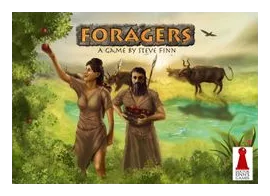
Foragers is a strategy game in which players take on the role of ancient foragers competing to be the most respected member of the tribe. In the game, foragers pick fruit from trees, fish in lakes, and hunt aurochs in the fields.
Core mechanisms
Key systems that shape the decisions players make.
Read the full game description
Foragers is a strategy game in which players take on the role of ancient foragers competing to be the most respected member of the tribe. In the game, foragers pick fruit from trees, fish in lakes, and hunt aurochs in the fields. After collecting these foods, the foragers return to a fire pit, where they "share" their food with the tribe and earn victory points. In addition, the foragers sometimes happen upon tools, which allow them to forage, fish, or hunt more efficiently. Of course, foragers are not completely altruistic and so they occasionally fight with each other to earn respect. The player who can best optimize their food and tool gathering, while also avoiding or winning skirmishes is the one who eventually earns the tribe leader title. The game is played over a predetermined number of rounds, depending upon the number of players. In each round, all players simultaneously choose an action card, from a hand of 3 action cards (drawn from a deck of 10) to use for that round. Each action card lists 5 different actions, but a player may only use 4 of those actions each round. Then, in clockwise order, each player performs 1 of the actions on their card until all players have performed 4 actions. Such actions include things like: walking, foraging, eating, discovering, resting, sharing, and picking up a tool. When players pick up food, they place it on their tableau, which tracks the food's freshness. At the end of each round, a "spoilage card" is flipped and all players "age" their food (i.e., move them along a food track). As the food gets older, it does not provide as much energy if eaten. Also, to score victory points, players must "share" their food before it spoils. In this sense, the players are racing not only against each other, but against nature.