Overview
At a glance
Is this game right for my group?
ABG editorial scores on a 1–5 scale.
Harder to teach
High replayability
Highly interactive
Scales well
Deep strategy
How it plays
How does it play?
Five-up is a point Traditional Games: Dominoes game in the "Fives Family" of Traditional Games: Dominoes games played with a standard Western Dominoes set of 28 tiles. This variation adds the ends of the dominoes to make a multiple of five for scoring.
Core mechanisms
Key systems that shape the decisions players make.
Pattern Building
Place elements to create arrangements that satisfy scoring or action patterns.
Pattern Recognition
Identify recurring visual, spatial, or logical arrangements.
Tile Placement
Place tiles to build a shared or personal spatial arrangement.
Team-Based Game
Players compete in fixed teams and coordinate toward a shared team result.
Read the full game description
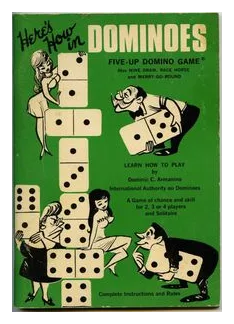
Five-up is a point Traditional Games: Dominoes game in the "Fives Family" of Traditional Games: Dominoes games played with a standard Western Dominoes set of 28 tiles. This variation adds the ends of the dominoes to make a multiple of five for scoring. Five-up is very similar to other games such as All Fives, Muggins, and Sniff. In Five-up, each player starts out with five dominoes in their hand, and the first player can play any domino in their hand. Thereafter, each player must play a domino from their hand if they can match it to a domino end on the table. If they cannot play a domino from their hand, they must draw from the "boneyard" until they can play a domino on the tableau. If the ends of the dominoes add up to a multiple of five, the player adding the domino scores one (1) point for each multiple of five (5) (IE: if the ends added up to ten (10), the player would score two (2) points). The first player that plays their last domino from their hand, adds up the count remaining in their opponent's hand and scores the total divided by five (5) (IE: if the opponent had a count of fifteen (15) in their hand, the scorer would score three (3) points). Five-up is played to a score of 61, and is usually played with a Cribbage board to keep score. Five-up is unique in that every double domino played is a possible "spinner," and plays can be played on all four sides of a "spinner." The rules for Five-Up were standardized and popularized in the 60's by Dominic C. Armanino, who wrote at least four books on Dominoes. He was a strong advocate and PR agent for this version of the game. Life magazine called this version, A big new go for the humble domino.