ABG All Board Games
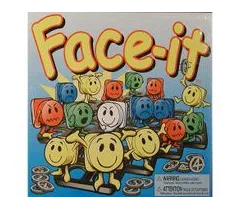
Face-it box art

Face-it

Players

2-4

Time

?-?

Age

5+

Weight

1

Rating

5.47

Fit

Teach 2.4

Teaching signal

Replay 4.0

High replayability

Interaction 3.7

Highly interactive

Scaling 4.4

Scales well

Strategy 4.5

Deep strategy

Control 2.8

Luck-sensitive

Table feel

Face-It has a high level of direct confrontation with battles and competitive actions that have immediate impact on opponents. It also offers strategic depth through resource denial and market manipulation. Players need to frequently pay attention to others' strategies and turns. However, the game does not emphasize cooperation as much. Overall, Face-It has a good interaction score of 7.35.

Replay value

Face-It has a high variability gameboard, with different experiences offered each time it is played. The expansions available add new content and gameplay elements, enhancing the replay value. The game also offers deep strategic possibilities and room for players to improve their strategy over time. The player interaction score is moderate, and the game scales well with different numbers of players. While it may take some time to learn, the easiness to learn score is still within a reasonable range. Overall, Face-It has a strong replayability score of 8.02.

Luck profile

The final luck score for Face-It is 5.67, indicating a moderate influence of luck on the game outcome. Random elements have a notable but not exclusive impact on the game, and players have some ability to mitigate the effects of randomness through strategic decisions and planning. The game is a balanced mix of luck and strategy, with neither element dominating the outcome.

Overview

On a grid you place one of your 4 tiles on the board trying to make as large sets as possible. There are four colours (faces) and a special white tile. You get points for how large the group of like faces that border on each other are. The points are taken from your neighbor. The points are in the form of coins from 1 to 5 in worth forcing kids to actually do math (shudder). The tiles is replaced after playing and if the white tile is drawn it allows the player to steal a tile from another player and the white tile is then replaced in the bag for others to possibly draw again in the future. For the younger kids it can teach color matching. You can also play with the expressions on the tiles (Happy, sad, scared and mad), such as when you play a tile you have to make the expression. A simple game for ages 3 to 7 (although the box says 5 and up)

Media

No media imported yet.

Editions

Edition Year Language Publisher / Region
No editions imported yet.

Files

No files imported yet.

Credits

Designers

3
Gary Cowley Roy Cowley Wayne Hurley

Publishers

2
CoCoCo Talicor/Aristoplay