Overview
At a glance
Is this game right for my group?
ABG editorial scores on a 1–5 scale.
Harder to teach
High replayability
Highly interactive
Scales well
Deep strategy
How it plays
How does it play?
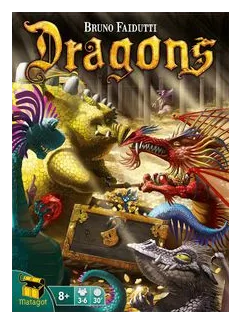
In Dragons, you get to experience life as a dragon, swooping down from the sky and swooping up all types of things. You want treasure, of course, because what dragon doesn't like shiny bling?
Core mechanisms
Key systems that shape the decisions players make.
Read the full game description
In Dragons, you get to experience life as a dragon, swooping down from the sky and swooping up all types of things. You want treasure, of course, because what dragon doesn't like shiny bling? You need food as well, though, so pick up a few cattle or sheep along the way to keep your belly full. Grab some armor or shields as treasures from fallen soldiers who thought they could take you down, perhaps put your claws on one fancy ring, and beware cursed items that look nicee but bite your points in the end. To play the game, you shuffle the deck of cards, then divide it into a few smaller decks. One player picks up the first deck, places the top card face up on the table, then passes the deck to the next player. Players keep laying out cards and passing the deck — with a number of face-up piles equal to the number of players — but players can also claim one of the piles by placing their dragon figure on it. Once all but one player have claimed a pile, the remaining player takes any cards remaining in the deck along with the final pile. You then grab the next deck and repeat this process until all the decks have been split among the player-dragons. Players then compare their hauls, and whoever took the least food is eliminated from the game. (In a five- or six-player game, you separately determine who took the fewest sheep and who took the fewest cattle, with both of those players being eliminated.) The remaining dragons then tally the value of their loot to see who wins.