Overview
At a glance
Is this game right for my group?
ABG editorial scores on a 1–5 scale.
Harder to teach
High replayability
Highly interactive
Scales well
Deep strategy
How it plays
How does it play?
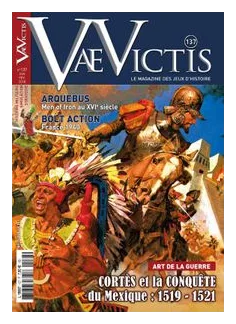
The third game of the Gold & steel series, Cortés et la conquête du Mexique 1519-1521 (Cortes and the conquest of Mexico 1519-1521) is a historical simulation featuring the “first war of the worlds”; Spain, the rising European power and the Central America dominant civilization, the Aztec Empire. This a medium to high complexity 2 players game.
Core mechanisms
Key systems that shape the decisions players make.
Area Majority
Compete to have the strongest presence in areas that award control or points.
Area Movement
Move pieces between connected regions rather than along individual spaces.
Dice Rolling
Roll dice to introduce uncertainty into actions, production, movement, or resolution.
Chit-Pull System
Draw tokens to determine which units, factions, or events activate next.
Minimap Resolution
Resolve broader movement or conflict on a smaller linked representation of the map.
Simulation
Model a real or imagined system through detailed cause-and-effect rules.
Read the full game description
The third game of the Gold & steel series, Cortés et la conquête du Mexique 1519-1521 (Cortes and the conquest of Mexico 1519-1521) is a historical simulation featuring the “first war of the worlds”; Spain, the rising European power and the Central America dominant civilization, the Aztec Empire. This a medium to high complexity 2 players game. One turn is 2 months, and the game is played in 14 turns. One player plays the role of the Aztec Empire, or the Triple Alliance (an alliance of three city-states: Mexico-Tenochtitlan, Texcoco, and Tlacopan) and the other player plays the glorious Conquistadors lead by Hernan Cortes. The objectives are to take control of the different territories (city-states and the most important Mexico-Tenochtitlan), to win pitched battles or major sieges, to eliminate units and leaders by sacrifice! This is both a strategic & tactical game with armies and garrisons evolving on the main strategic map showing Meso-Indian Central America and units fighting on a tactical map featuring a typical XVIth century battleground. Spanish units are swords & bucklers, arquebusiers, crossbowmen, ginetes (light cavalrymen), medium cavalrymen, and early cannons (from 50 men at full strength, 30 horsemen or 10 cannons of all calibers). The Indians units (all Aztecs, Tlaxcaltec and All other Indians peoples) are knight orders such as Jaguars, Eagles, Cuachicqueh, javelins throwers, bowmen and most feared by Spaniards, the slingers. The ambience of that period is added with tactical chits with specific application for the fights – shooting and close-combat – (for the Conquistadors: war dogs, infantry or cavalry charge, fight to death, kill the leader and for the Aztecs : arrows and javelins harassment, zigzag, shock, feint movement, wrapping up, hidden units, noria) and events such as rain, sacrifice, fight to death, no fight or betrayal. There are two combat tables; one used by Spaniards, the fight to death (the objective is to kill most enemies) and the flower war used by the Aztecs (the objective is to sacrifice most Spanish soldiers). The complete sequence of a turn: I/ Spain 1) Reinforcement, replacement 2) Strategic move 3) Attrition phase 4) combat phase (battles & sieges) II/ Aztec Empire Same sequence III/ Diplomatic phase Change of alliance Check for victory (description from the designer)