Overview
At a glance
Is this game right for my group?
ABG editorial scores on a 1–5 scale.
Harder to teach
High replayability
Highly interactive
Scales well
Deep strategy
How it plays
How does it play?
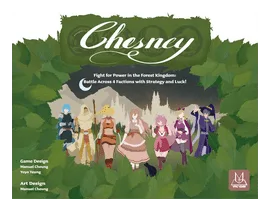
Chesney is a game for 4 - 10 players filled with elements of strategy, social deduction, and factions that may change throughout the game. At the start of the game, Faction and Character Cards (for Advanced Mode) are not revealed.
Core mechanisms
Key systems that shape the decisions players make.
Hidden Movement
One or more pieces move secretly while opponents infer their locations.
Hidden Roles
Players conceal team, loyalty, or identity information from one another.
Deduction
Combine clues and exclusions to identify hidden information.
Dice Rolling
Roll dice to introduce uncertainty into actions, production, movement, or resolution.
Hand Management
Time and sequence a limited hand of cards to preserve future options.
Read the full game description
Chesney is a game for 4 - 10 players filled with elements of strategy, social deduction, and factions that may change throughout the game. At the start of the game, Faction and Character Cards (for Advanced Mode) are not revealed. Players can freely converse and make any claims at any time during the game. On your turn, you need to take different actions using the cards or characters in your hand to find potential allies or defeat potential enemies during the game. The goal of each round of the game is to have only one faction remaining in control of the battlefield. Please note that factions are not static or fixed. With the Dual Faction card system, players may change their own or another Faction. This is absolutely a chaotic yet compelling faction game. Challenge your social skills and strategic thinking (or maybe your luck), and become a legend in the Kingdom of Catrolia! Gameplay: 1. Players take turns performing Appearance ?Plan ?Declare ?Rest on their turn via cards. 2. A Faction being revealed does not directly cause a player to lose the game or suffer apparent losses. A player's faction has the opportunity to change during the game, and the player needs to adjust strategies according to the current situation and their own interests to find the most advantageous faction. Yesterday's enemy may become today's ally. 3. Attacking other players can cause direct damage and narrow the base number of players for Faction Fudgment, but Faction Cards can produce more effective results. 4. Players only need to answer truthfully when showing faction markers and determining if the game continues. Players can engage in negotiations or bluffs with other players during the process. 5. The game has a considerable strategy, and players should carefully consider the consequences of each decision. —description from the publisher