Overview
At a glance
Is this game right for my group?
ABG editorial scores on a 1–5 scale.
Harder to teach
High replayability
Highly interactive
Scales well
Deep strategy
How it plays
How does it play?
Anno Domini 947 a. C.
Core mechanisms
Key systems that shape the decisions players make.
Read the full game description
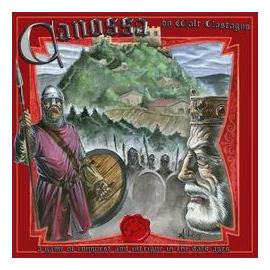
Anno Domini 947 a. C. marks the royal marriage between Lothar II, King of Italy, and Adelaide of Burgundy. Unfortunately, soon after this union is sadden due to the death of the King. The belief is that the King was killed by Berengario II, Marquis of Ivrea, hungry to reign the Kingdom. Adelaide, indignant, opposes this new regency, as Berengario II tries to force her to marry his own son, Adalbert of Ivrea. She runs away to seek refuge in the Canossa Castle, strategic in its position, owned and governed by Azzo Adalbert. Here comes the siege of the castle, and this is what we are going to recall: on one side Berengario II and his son, Adalbert, are besieging, and on the other Adelaide of Burgundy and Azzo Adalbert are under siege; in defense of them comes Otho I, Emperor of Germany, with his knights. Each courageous player will guide 2 of the Emperor’s knights, to try to free Adelaide, allowing Otho I to marry her in 952, and thus becoming the new King of Italy. Goal of the game is to achieve a higher score than your opponents. Points are achieved by either taking enemy tiles or creating a way out of the Canossa Castle (3 points). Enemy tiles, like all other tiles, are captured when you place one of your knight-pawn on one of them. Captured tiles must always be perfectly visible to all other players. The game ends when a player creates a way out of the Canossa Castle (that means to seize the Canossa Castle tile). In order to seize the Canossa Castle tile or any other enemy tile players must create a way out that enables that tile, on which there’s the knight-pawn, to be moved off of the board.