Overview
At a glance
Is this game right for my group?
ABG editorial scores on a 1–5 scale.
Harder to teach
High replayability
Highly interactive
Scales well
Deep strategy
How it plays
How does it play?
Alea iacta est... 49 B.C.
Core mechanisms
Key systems that shape the decisions players make.
Grid Movement
Move pieces between adjacent spaces on a regular grid.
Dice Rolling
Roll dice to introduce uncertainty into actions, production, movement, or resolution.
Movement Points
Spend a movement allowance across spaces with different costs.
Hexagon Grid
Use a hexagonal map where each space connects evenly in six directions.
Line of Sight
Visibility between pieces determines valid targets, movement, or effects.
Read the full game description
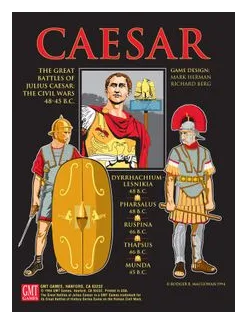
Alea iacta est... 49 B.C. Rome is in turmoil. Armed mobs rule the streets. The First Triumvirate - overseers of the last days of the Roman Republic - has disintegrated. The Senate and the People have two options: on the one hand is the overweening ego, ambition, but limited military vision of Gnaeus Pompeius Magno - Pompey the Great. On the other hand is one of history's greatest - and most schemingly ambitious - political/military figures, the conqueror of Gaul, Caius Julius Caesar. In Italy, at the edge of the Rubicon River, word of the stalemate has reached Caesar and his XIII Legion. He intones, for posterity: Ialea acta est... the die is cast. CAESAR: The Great Battles of Julius Caesar - The Civil Wars 48-45 B.C. recreates 5 battles, using the GMT Great Battles of History (GBoH) basic system: Pharsalus (Tessaly), 48 B.C. Dyrrhachium-Lesnika (Illyria), 48 B.C. Thapsus (Africa), 46 B.C. Ruspina (Africa), 46 B.C. Munda (Spain), 45 B.C.