Overview
At a glance
Is this game right for my group?
ABG editorial scores on a 1–5 scale.
Harder to teach
High replayability
Highly interactive
Scales well
Deep strategy
How it plays
How does it play?
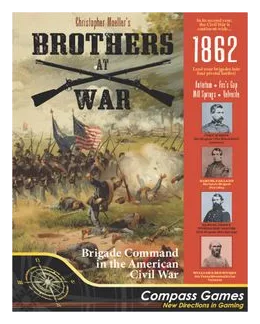
Brothers at War: 1862 is a quick-playing, tactical wargame exploring civil war brigade command. Units are regiments, batteries and companies of skirmishers.
Core mechanisms
Key systems that shape the decisions players make.
Campaign Card Play
Play cards to command conflicts and carry consequences through a campaign.
Dice Rolling
Roll dice to introduce uncertainty into actions, production, movement, or resolution.
Chit-Pull System
Draw tokens to determine which units, factions, or events activate next.
Hexagon Grid
Use a hexagonal map where each space connects evenly in six directions.
Read the full game description
Brothers at War: 1862 is a quick-playing, tactical wargame exploring civil war brigade command. Units are regiments, batteries and companies of skirmishers. This is a quadrigame or set of four games, each featuring a full-size, 22x34" game map and covering battles from 1862: Antietam, 5am-9am, September 17th South Mountain, 9am-6pm, September 14th Mill Springs, 7am-12pm, January 17th Bloody Valverde, 10am-5pm, February 21st Command rules are simple and abstracted. There are no combat results tables. Combat and all checks are resolved using six-sided dice, in which results of 5-6 mark success, and 1-4 failure. Brigades activate via chit pull, with their constituent units moving and fighting individually. Stacking is limited to two units per hex. Massive 1.5” hexes allow two 3/4” units to fit side by side… no information is obscured! Distinctions are made between formed and unformed infantry, deployed and limbered artillery, mounted and dismounted cavalry. Unit facing is not an element of play. Instead, unit deployment in adjacent hexes can trigger pass-through fire, which simulates flanking fire, or fire on compressed lines (both dangerous situations for civil war units). Battle Cards introduce an element of uncertainty and excitement to play. Unique off-map displays track every brigade's reserves and casualties. Once a unit's reserves are used up, it becomes exhausted and liable to break. Game Scale: Game Turn: 20 minutes Hex: 100 yards / 91 meters Units: Regiments and Batteries Game Inventory: Four 22 x 34" full color mapsheets (1.5"/38mm hex size) Four dual-side printed countersheets (520 .75"/19mm counters) One dual-side printed countersheet (228 .5"/12.7mm counters) One 24-page full color rulebook One 36-page full color scenario book Five dual-side printed brigade display player aid cards Two dual-side printed activation track display player aid cards Two dual-side printed sequence of play/terrain effects/combat chart player aid cards One deck of 52 battle playing cards Two save rolls playing cards Six off-board artillery playing cards Six 6-sided dice (3 blue/3 gray) Solitaire Playability: Medium Complexity Level: Medium-high Players: 2 or more Playing Time: 1-4 hours