Overview
At a glance
Is this game right for my group?
ABG editorial scores on a 1–5 scale.
Harder to teach
High replayability
Highly interactive
Scales well
Deep strategy
How it plays
How does it play?
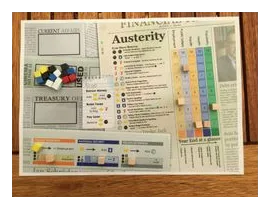
Austerity is a compact solo game in which you run a nation struggling under the burden of international debt - make decisions about police funding, investment in private enterprise, whether to crack down on welfare cheats and when best to borrow more money...
Core mechanisms
Key systems that shape the decisions players make.
Read the full game description
Austerity is a compact solo game in which you run a nation struggling under the burden of international debt - make decisions about police funding, investment in private enterprise, whether to crack down on welfare cheats and when best to borrow more money... but if you don't escape debt before your bad decisions catch up to you, you'll be out of office and out on the street with the rest of them! The state of the nation's finances are represented by a number of coloured cubes in a bag; these are drawn in pairs, and each pair corresponds to a different event that occurs - and which often ask the player to make a decision. The player adds cubes to the bag by choosing to fund different public institutions, borrow even more money or raise taxes, meaning that the player decides how the nation's money is spent, but doesn't directly choose the effects that spending has on the country.