Overview
At a glance
Is this game right for my group?
ABG editorial scores on a 1–5 scale.
Harder to teach
High replayability
Highly interactive
Scales well
Deep strategy
How it plays
How does it play?
Linked game discovered from BGG. Full scrape pending.
Core mechanisms
Key systems that shape the decisions players make.
Open Drafting
Select cards or items from a shared face-up display.
Hand Management
Time and sequence a limited hand of cards to preserve future options.
Worker Placement
Commit limited workers to action spaces before opponents occupy them.
Hexagon Grid
Use a hexagonal map where each space connects evenly in six directions.
Read the full game description
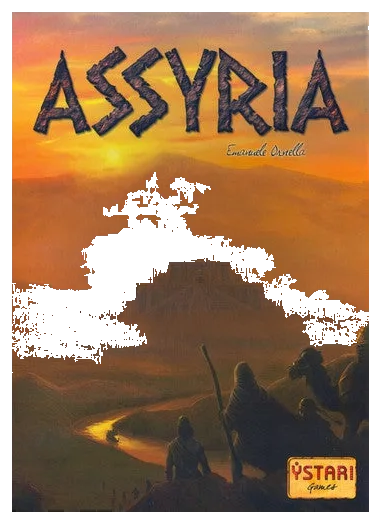
In Assyria, players represent tribes living in Mesopotamia, trying to develop on the desert and a limted fertile area located between two rivers that divide the board. In their quest for power (points), players build Ziggurats (permanent outposts), wells, make sacrifices to gods and try to get along with nobles of Assur - the capital of Assyria. The game is a light-weight eurogame, built around the short-term rapid point gains vs long-term investments dilemma. General flow of play is as follows: Phase 1: Players get resources for expansion and decide on play order In this phase, players pick cards with resources that enable expansion on the board. In general he/she who gets most food, plays last. First player expands with least food. Phase 2: Players expand on the board to earn points or money. Players begin to form strings and/or clusters of huts and pay for placing them with their food cards. Depending on where huts are placed, they either score points or earn camels (money). Phase 3: Players spend money/camels on various investments. A player either goes for one-time bonuses from the nobles of Assur, or makes long-term investments by offerings to gods and building Ziggurats. The game lasts for three eras, made up of 2-3 of such cycles. After each era comes the flood: the board is partially cleaned up, but players also capitalize on their investments from phase 3. Each round, players also score points for huts (those built on fertile land between the two rivers bring more points) and ziggurat tiles. In comparison to other games from Ystari's series - Assyria is lighter than Caylus, Olympos, Ys or Sylla (in terms of complexity, available choices - represented by numerous tiles, cards, icons, cards etc. that need to be remembered and can be combined during play), but heavier than Yspahan, Mykerinos or Metropolis.