Overview
At a glance
Is this game right for my group?
ABG editorial scores on a 1–5 scale.
Harder to teach
High replayability
Low interaction
Scales well
Deep strategy
How it plays
How does it play?
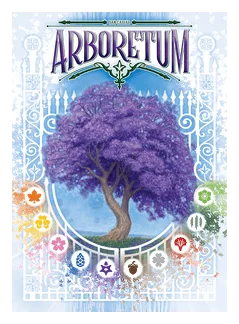
Arboretum is a strategy card game for 2-4 players, aged 10 and up, that combines set collection, tile-laying and hand management while playing in about 25 minutes. Players try to have the most points at the end of the game by creating beautiful garden paths for their visitors.
Core mechanisms
Key systems that shape the decisions players make.
Pattern Building
Place elements to create arrangements that satisfy scoring or action patterns.
Set Collection
Gather related items that become more valuable when scored together.
Hand Management
Time and sequence a limited hand of cards to preserve future options.
Tile Placement
Place tiles to build a shared or personal spatial arrangement.
Read the full game description
Arboretum is a strategy card game for 2-4 players, aged 10 and up, that combines set collection, tile-laying and hand management while playing in about 25 minutes. Players try to have the most points at the end of the game by creating beautiful garden paths for their visitors. The deck has 80 cards in ten different colors, with each color featuring a different species of tree; each color has cards numbered 1 through 8, and the number of colors used depends on the number of players. Players start with a hand of seven cards. On each turn, a player draws two cards (from the deck or one or more of the discard piles), lays a card on the table as part of her arboretum, then discards a card to her personal discard pile. When the deck is exhausted, players compare the cards that remain in their hands to determine who can score each color. For each color, the player(s) with the highest value of cards in hand of that color scores for a path of trees in her arboretum that begins and ends with that color; a path is a orthogonally adjacent chain of cards with increasing values. For each card in a path that scores, the player earns one point; if the path consists solely of trees of the color being scored, the player scores two points per card. If a player doesn't have the most value for a color, she scores zero points for a path that begins and ends with that color. Whoever has the most points wins.